
 Available in US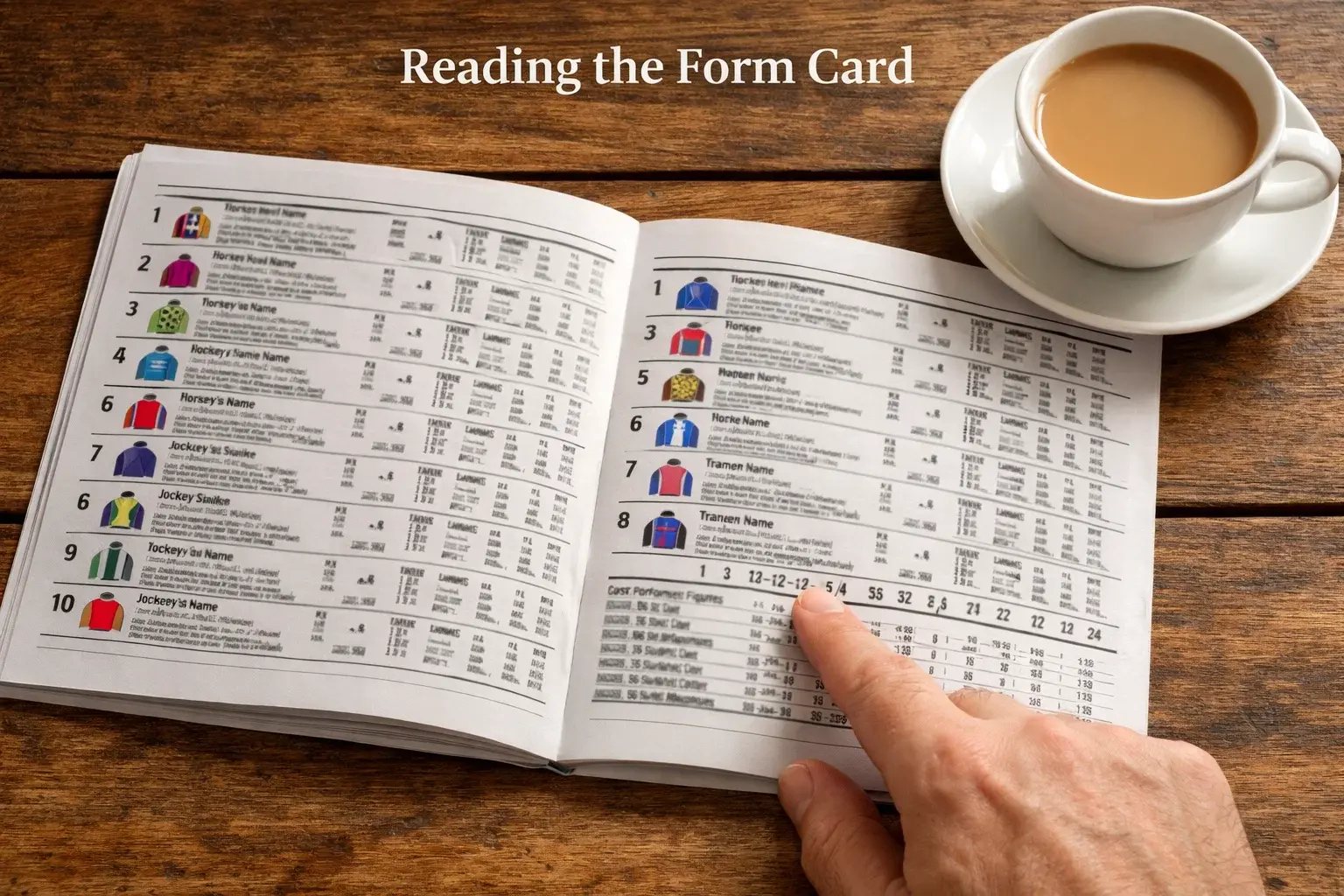
The Racecard Is Your Betting Research in Miniature
A horse racing form card packs an extraordinary amount of information into a small space. It tells you the name of every runner, their recent results, who trains and rides them, what they weigh, how old they are, and what equipment they’ll be wearing. If you can read a racecard fluently, you already have most of the raw data you need to make an informed betting decision. If you can’t, you’re guessing — and the market is not generous to guesswork.
Learning how to read a horse racing card in the UK isn’t difficult, but it does require knowing what each piece of data means and, crucially, which pieces matter most for the type of race you’re evaluating. With average field sizes on Flat Premier racedays reaching 10.86 in 2024 — the highest since before the pandemic, per BHA data — every runner on the card is a data point you need to process. The more runners, the more important it becomes to filter effectively rather than just scanning names and hoping for the best.
The Header: Race Conditions, Class, Distance, Going
Before you look at a single horse, read the top of the card. The race header contains the conditions that define what you’re watching, and those conditions shape which form is relevant and which isn’t.
The race title usually includes the sponsor name, the race type (handicap, maiden, novice, conditions, listed, group), and the distance in miles and furlongs. A “Class 4 Handicap” over one mile two furlongs on good ground is an entirely different contest from a “Group 1 Stakes” over six furlongs on firm ground. Horses that excel in one may be entirely unsuitable for the other.
Class matters enormously. British Flat racing runs from Class 7 (the lowest) through to Class 1, which includes Group and Listed races. A horse dropping in class is stepping down in quality — potentially meeting weaker opposition, which should improve its chances. A horse rising in class faces the opposite challenge. The racecard won’t explicitly tell you whether a horse is stepping up or down, but comparing the race class to the horse’s recent results will reveal it quickly.
Distance is stated in miles and furlongs (one furlong is 220 yards, or roughly 201 metres). Some horses are specialists over sprint distances — five to six furlongs — while others need a mile and a half or more to produce their best work. The form figures, which we’ll decode in the next section, only become meaningful when you consider them in the context of the distance at which they were achieved.
The going — the state of the ground — is posted in the header or updated separately before racing begins. It ranges from hard and firm through good to soft and heavy. A horse with winning form on good ground might struggle when the rain turns the track into a heavy bog. This single variable can override everything else on the card, and it changes right up until the first race.
Form Figures — What Each Digit and Symbol Means
Form figures are the most information-dense element of any racecard, and they look intimidating at first glance. A sequence like “2333-413” is actually a chronological record of the horse’s finishing positions in its most recent races, read from left to right with the most recent result on the far right.
The digits represent finishing positions: 1 means first, 2 means second, and so on up to 9. A “0” indicates the horse finished tenth or worse — not a great sign, though context matters. The hyphen (-) separates results from different seasons. So “2333-413” tells you the horse finished second, then three thirds in one season, followed by fourth, first, and third in the current season. Its most recent run was a third-place finish.
Beyond numbers, several letters and symbols carry specific meaning. “F” means the horse fell — relevant only in National Hunt racing. “U” means the jockey was unseated. “P” means the horse was pulled up, refusing to complete the race or withdrawn by the jockey due to being beaten. “R” means it refused a fence. “C” means it was carried out by another horse’s mistake. “B” means it was brought down by a falling horse.
Two other symbols appear frequently. “D” denotes a disqualification after finishing. A slash (/) indicates a significant gap in the racing record — at least a year between runs. A horse returning from a long absence (form showing “/” or multiple hyphens) is inherently less reliable because you don’t know how it has trained or whether it retains its previous ability.
The key to reading form figures isn’t just identifying what happened, but asking why. A horse that finished sixth of six in a Group 1 race might have run better than one that won a Class 6 maiden. Context — the quality of the race, the number of runners, the margin of defeat — turns raw digits into meaningful analysis. Racecards in printed form are compressed; online versions on sites like the Racing Post expand each figure with race details, margins, and comments, which is where the real depth sits.
Official Ratings and Handicap Marks
Every horse that has run three or more times in Britain (or that has been assessed from form elsewhere) receives an Official Rating (OR) from the BHA handicapper. This number, typically ranging from around 40 to 130+ for Flat horses, represents the handicapper’s assessment of the horse’s ability. The higher the number, the better the horse is judged to be.
In handicap races, the Official Rating directly determines the weight the horse carries. A higher-rated horse carries more weight to theoretically equalise its chances against lower-rated opponents. The racecard shows each horse’s OR alongside its allocated weight in stones and pounds. The difference between the top weight and the bottom weight in a handicap can be two stone or more — a gap that reshapes the entire market.
What matters for betting is not the absolute rating but the direction of travel. A horse rated 85 that has recently been running in races off a mark of 90 has been dropped by the handicapper — it’s now effectively 5lbs better off than in its most recent races. This is what experienced punters call “well handicapped,” and it’s one of the most reliable angles in form analysis. Conversely, a horse that won last time and has been raised 6lbs faces a tougher assignment from a higher mark.
The number of horses in training across Britain has been declining at roughly 1.5 per cent per year since 2022, with Jump horses hit particularly hard — down 6.5 per cent in the year to September 2024. This contraction means fewer runners per race at the lower end, which can make some handicaps less competitive and form figures less informative. Keeping an eye on field sizes as well as ratings helps calibrate how much weight to give the form.
Equipment Flags: Blinkers, Cheekpieces, Tongue-Tie
The racecard notes any headgear or equipment a horse will wear, using standardised abbreviations. These aren’t cosmetic — they signal that connections are trying to address a specific performance issue, and equipment changes often accompany significant form shifts.
Blinkers (b) restrict the horse’s peripheral vision, forcing it to focus straight ahead. They’re typically applied to horses that are easily distracted, hang towards the rail, or fail to concentrate in the closing stages. A horse wearing blinkers for the first time (denoted as “first-time blinkers” or “1” in some formats) is worth noting — trainers don’t apply them without reason, and the first-time effect can be dramatic, sometimes positive, sometimes disastrous.
Cheekpieces (cp) serve a similar purpose but are less restrictive. They limit sideways vision without fully blocking it. Horses that don’t respond to blinkers are sometimes switched to cheekpieces, or vice versa. A visor (v) is a hybrid — blinkers with a slit cut in one eye cup, allowing partial peripheral vision.
A tongue-tie (t) is exactly what it sounds like: a strap that ties the horse’s tongue down to prevent it from getting over the bit, which can restrict breathing during a race. Tongue-ties are common in National Hunt racing and are typically applied to horses that have shown signs of respiratory difficulty. Their presence on a racecard is a neutral flag — it’s an attempt to fix a problem, and the question is whether the fix works.
Hood (h) and eye shields (e/s) help calm nervous horses in the parade ring and on the way to the start. They’re removed before the race begins and don’t affect the actual running, but they indicate a horse with temperament issues. A horse that needs a hood to reach the start line is one whose behaviour might affect its performance unpredictably.
The general principle with equipment is straightforward: changes matter more than the equipment itself. A horse that has worn blinkers for its last ten runs is a horse in blinkers — that’s its normal state. A horse wearing blinkers for the first time, or having them removed after six starts, is flagging a deliberate intervention by the trainer. Those interventions are data points, and they deserve attention.
How to Read a Horse Racing Form Card — More on this topic at betting on horse racing.
See also Going Conditions in Horse Racing.
