
 Available in US
UK Betting on Horse Racing — The Data-Driven Guide
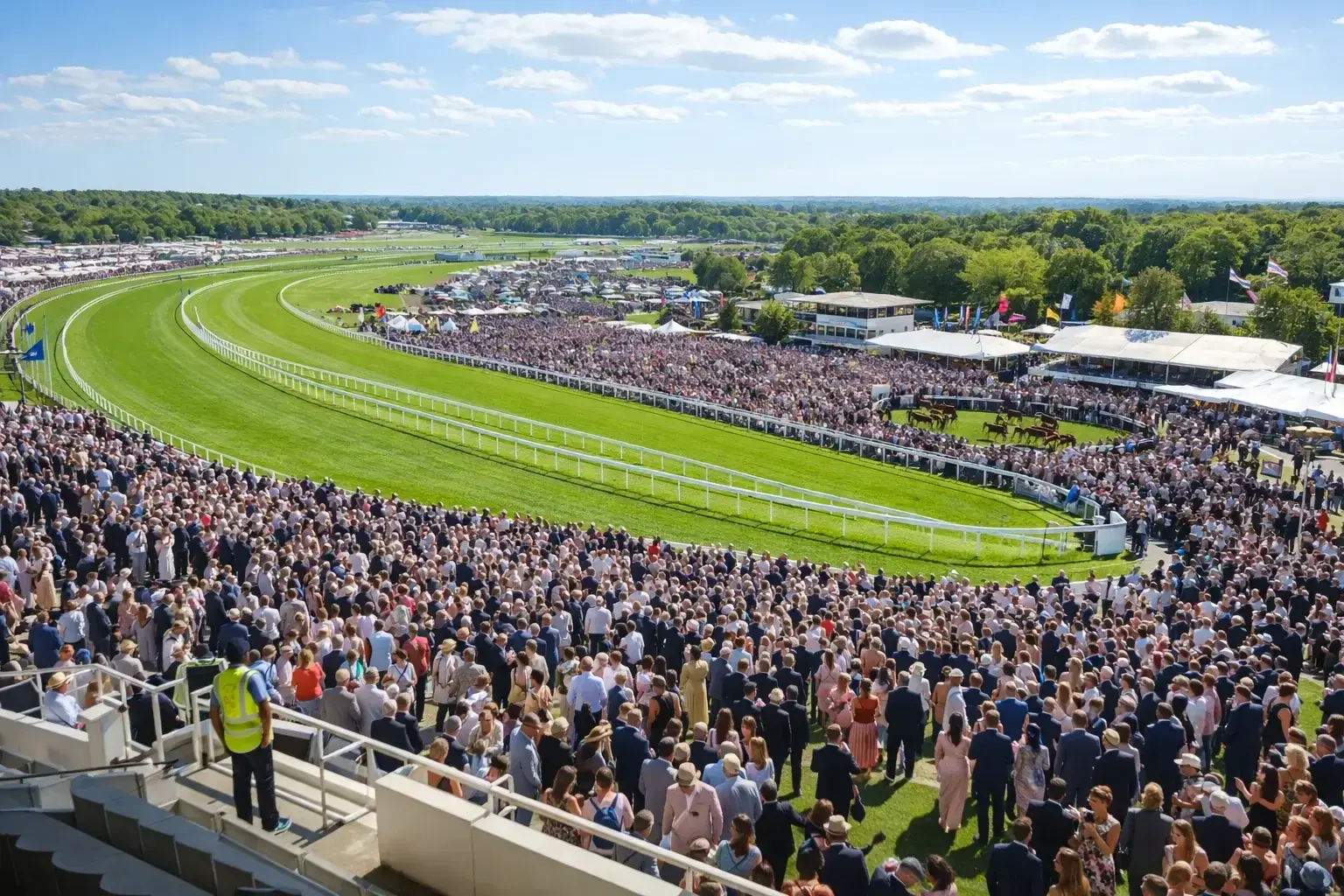
Horse racing betting in the United Kingdom is not a niche pastime propped up by nostalgia. It is a commercial ecosystem worth hundreds of millions in gross gambling yield, embedded in a sport whose total annual contribution to the British economy reaches £4.1 billion and supports roughly 85,000 jobs, according to the British Horseracing Authority's submission to the House of Commons Library. Strip away the heritage marketing and the top hats at Ascot, and what remains is a market shaped by regulation, data, and an audience that still turns up in person — over 5.03 million racegoers passed through British turnstiles in 2025, the first time attendance crossed five million since the pre-pandemic era.
"The racing industry has direct revenues in excess of £1.47 billion and makes a total annual contribution to the UK economy (including induced effects) of £4.1 billion." — British Horseracing Authority, submission to the Gambling Act Review.
This guide is built for anyone who wants to move beyond gut feeling and headline odds. Whether you are placing your first each-way bet or refining a staking plan you have used for years, the aim here is data-backed racing analysis — hard numbers drawn from the Gambling Commission, the BHA, and the Horserace Betting Levy Board, set alongside practical explanations of how UK racing betting actually works. No promotional partnerships, no bookmaker rankings, no affiliate links. Just a structured walk through the market, the mechanics, and the strategy that can make the difference between punting blind and punting with intent.
British racecourses are not just surviving; they are attracting younger visitors at a notable rate — under-18 attendance climbed 17% in 2025 to over 211,000, a sign that the sport's live appeal is widening rather than contracting. The betting side, however, tells a more complex story. Online wagering continues to grow while high-street betting shops shrink, and new regulatory checks are reshaping how much punters can stake and how quickly they can do it. Understanding that landscape is the first step toward making sharper bets.
The Numbers Behind the Odds
- UK horse racing generated £766.7 million in remote betting GGY during FY 2024–2025 — second only to football among British sports.
- Favourites win approximately 33% of all races, but blindly backing every market leader returns a net loss of around 7% on turnover — the bookmaker's margin is baked into the price.
- Over 5 million people attended British racecourses in 2025, yet the number of licensed betting shops continues to fall, down 1.8% year on year.
- The Horserace Betting Levy reached a record £109 million in 2025 — but a proposed tax harmonisation threatens the sport with £330 million in losses over five years.
- UK punters pay zero tax on winnings. The tax burden sits with the operators, currently at 15% Remote Gaming Duty.
The UK Horse Racing Landscape
The UK Horse Racing Betting Market in Numbers
The Gambling Commission's Industry Statistics for FY 2024–2025 put the total gross gambling yield of the British gambling industry at £16.8 billion, a 7.3% increase year on year. Within that figure, remote (online) betting on horse racing accounted for £766.7 million in GGY, while the combined online betting sector reached £2.6 billion — a 10.9% annual rise. Football still leads the online betting market with £1.3 billion in GGY, which means horse racing sits firmly in second place among British sports. That is worth emphasising, because a surprising number of guides still repeat the claim that horse racing is the UK's most popular betting sport. By revenue, it is not — but it remains the sport most closely tied to the betting industry's financial structure.
Horse racing is the only British sport that receives direct financial support from bookmakers through a statutory levy. No other discipline — not football, not tennis, not cricket — has this arrangement.
The headline numbers, however, mask a less comfortable trend. According to the BHA's Racing Report for Q3 2025, total betting turnover on British racing fell 4.2% over the first nine months of 2025 compared with the same period in 2024, and 12.8% compared with 2023. Average turnover per race dropped 5.8% year on year. The gap between rising bookmaker revenue and declining turnover is explained partly by higher gross margins — results at major festivals, especially the 2025 Cheltenham Festival, favoured bookmakers — and partly by regulatory changes that have trimmed the activity of high-staking customers.
This is not a market in crisis, but it is a market adjusting. The shift from volume to margin means that the industry's financial health looks better in GGY terms than it does in turnover terms. For bettors, the practical effect is subtle but real: fewer large bets in the market can narrow liquidity in exchange pools and, on occasion, compress the range of available prices at smaller meetings. At the flagship festivals, where media coverage and public interest concentrate, liquidity remains robust.
UK horse racing betting generates £766.7 million in online GGY annually — a substantial market, but one where turnover is declining even as bookmaker profits grow. Understanding this context matters before you place a single bet.
Flat Racing vs National Hunt — What Matters for Your Bets
British racing operates under two distinct codes, and each demands a different betting mindset. Flat racing runs primarily from April to October on level turf or all-weather surfaces, with distances ranging from five furlongs to two and a half miles. National Hunt — jumps racing — fills the autumn-to-spring window with hurdle races and steeplechases over obstacles, at distances from about two miles to four and a half. The overlap between the two codes has grown in recent years, with all-weather flat racing running year-round and some trainers campaigning horses across both disciplines, but the fundamental distinction remains: flat racing rewards speed and acceleration; National Hunt rewards stamina, jumping ability, and resilience on soft or heavy ground.
For betting purposes, the key difference lies in predictability. Flat racing fields, especially at Premier Racedays, have been growing — average field sizes on the flat reached 10.86 runners in 2024, their highest in recent years, according to the BHA's Full Year Racing Report. Larger fields mean more competitive races and a wider spread of odds, which creates more opportunities for value but also more scope for upsets. National Hunt fields are typically smaller, particularly in graded company, and the attrition rate from falls and unseated riders introduces a random element that flat racing lacks almost entirely.
The horse population tells another story. The number of horses in training has been declining at roughly 1.5% per year since 2022, with National Hunt experiencing the sharper contraction — a 6.5% drop in Jump horses between September 2023 and September 2024. Fewer horses means smaller fields in lower-class jumps races, which tends to compress odds and reduce the variety of competitive betting opportunities at the lower end of the fixture list. At the top — Cheltenham, Aintree, the King George — quality and field size have held steady, but the mid-tier programme is feeling the squeeze.
If you bet primarily on the flat, you are dealing with a code where form data is abundant, race replays are easily accessible, and the influence of the draw (starting position) at certain courses can be quantified. If your interest is jumps, the ground conditions and a horse's jumping technique become paramount — a brilliant stayer who cannot clear a fence is simply a liability. Knowing which code suits your analytical strengths is, frankly, the first strategic decision you make as a racing bettor.
Major Events: From Cheltenham to the Grand National
The British racing calendar is not a flat schedule of interchangeable fixtures. It is structured around a handful of marquee festivals that generate a disproportionate share of betting turnover, media attention, and — for bookmakers — profit or loss. Understanding when these events fall and what they demand from bettors is part of the discipline.
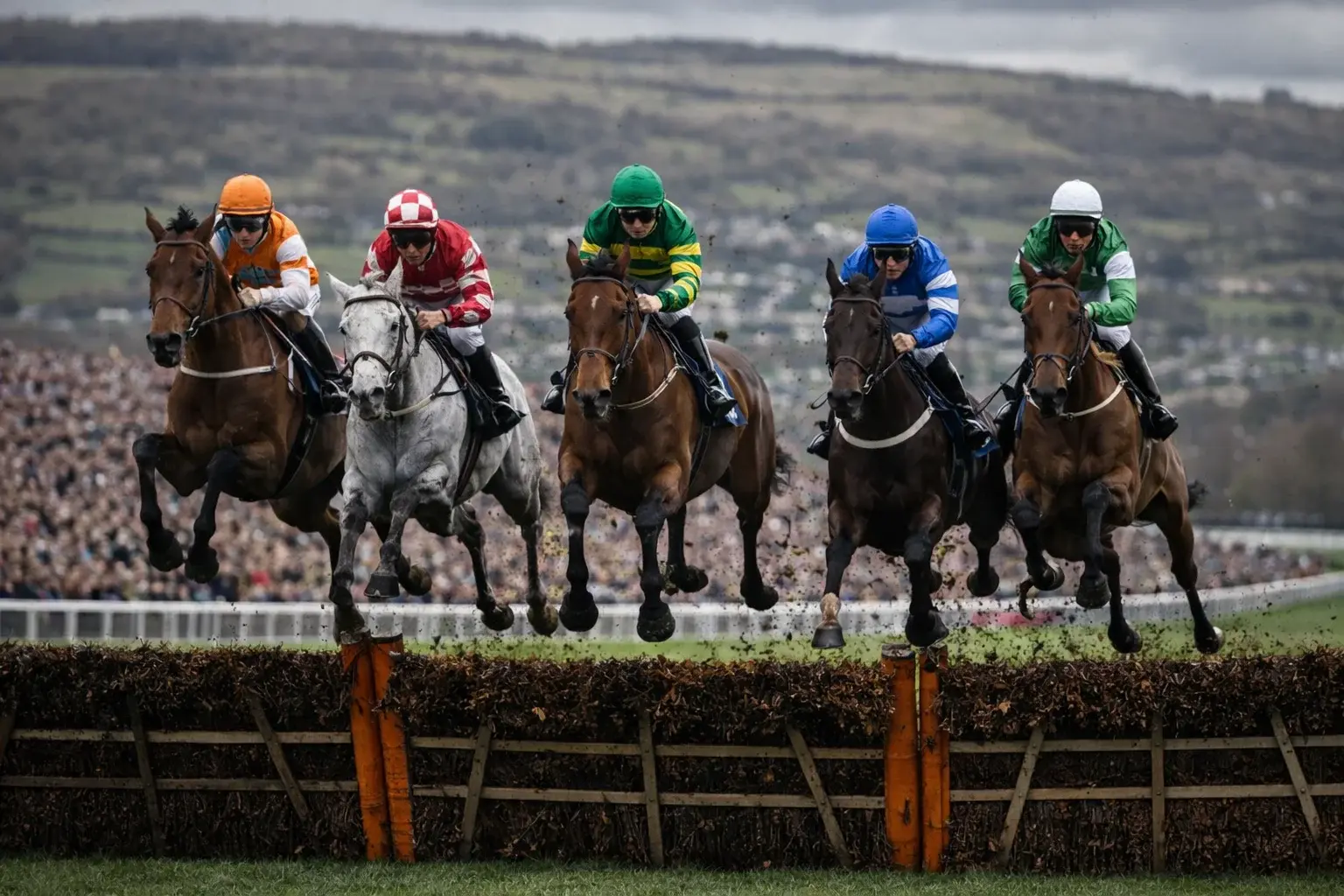
The Cheltenham Festival in March is the pinnacle of the National Hunt season: four days, 28 races, and an atmosphere that sits somewhere between a sporting arena and a financial exchange. The impact on the betting market is measurable. Alan Delmonte, Chief Executive of the Horserace Betting Levy Board, noted that the 2025 Cheltenham Festival produced particularly bookmaker-friendly results, and that this was not the first time the event had materially shifted the annual levy yield — a reflection, he said, of the essential unpredictability of the sport.
Three weeks later comes the Grand National Festival at Aintree, headlined by the most famous steeplechase in the world. The Grand National itself draws bets from millions of people who do not wager on any other race all year, which distorts the odds market and makes it one of the most inefficient betting heats on the calendar. Attendance at the 2025 Aintree Festival rose 4.1% year on year, according to the Racecourse Association's H1 2025 report.
Royal Ascot in June is the flat season's crown event — five days of top-tier Group racing, large fields, and the biggest concentration of high-class two-year-old and three-year-old form in the calendar. Attendance there grew 4.8% in 2025. In the same period, the Guineas Festival at Newmarket surged 13.2%, suggesting that the appetite for premium flat racing is expanding rather than consolidating.
Between these peaks sit the Epsom Derby in early June, Glorious Goodwood in late July, the Ebor Festival at York in August, and the St Leger at Doncaster in September. The winter jump programme builds toward the King George VI Chase at Kempton on Boxing Day and the Welsh Grand National at Chepstow in late December. Each event rewards different preparation — Cheltenham demands months of ante-post research; the Grand National rewards a grasp of handicap weights and course experience; Royal Ascot is a form-study exercise in speed figures and class. The seasonal concentration of these events is reflected in participation data: according to the Gambling Survey for Great Britain (Wave 2, 2025), 7% of UK adults had bet on horse racing in the preceding four weeks during April–July 2025, up from 4% in the January–April wave — a spike driven by the Cheltenham, Aintree, and Royal Ascot cluster. The spring 2026 calendar is already shaping up, with the Cheltenham Festival and Grand National providing the first major test of this year's jumps form.
The major festivals drive a disproportionate share of betting turnover and market volatility. Timing your preparation around these events — rather than betting uniformly across the calendar — is one of the simplest edges available.
How Betting on Horse Racing Works
How Horse Racing Odds Work
Odds in horse racing serve two purposes simultaneously: they tell you how much you stand to win, and they express the market's view of how likely a horse is to win. Every price on a racecard is a probability wrapped in a payout ratio, and learning to read both layers is essential to data-backed racing analysis.
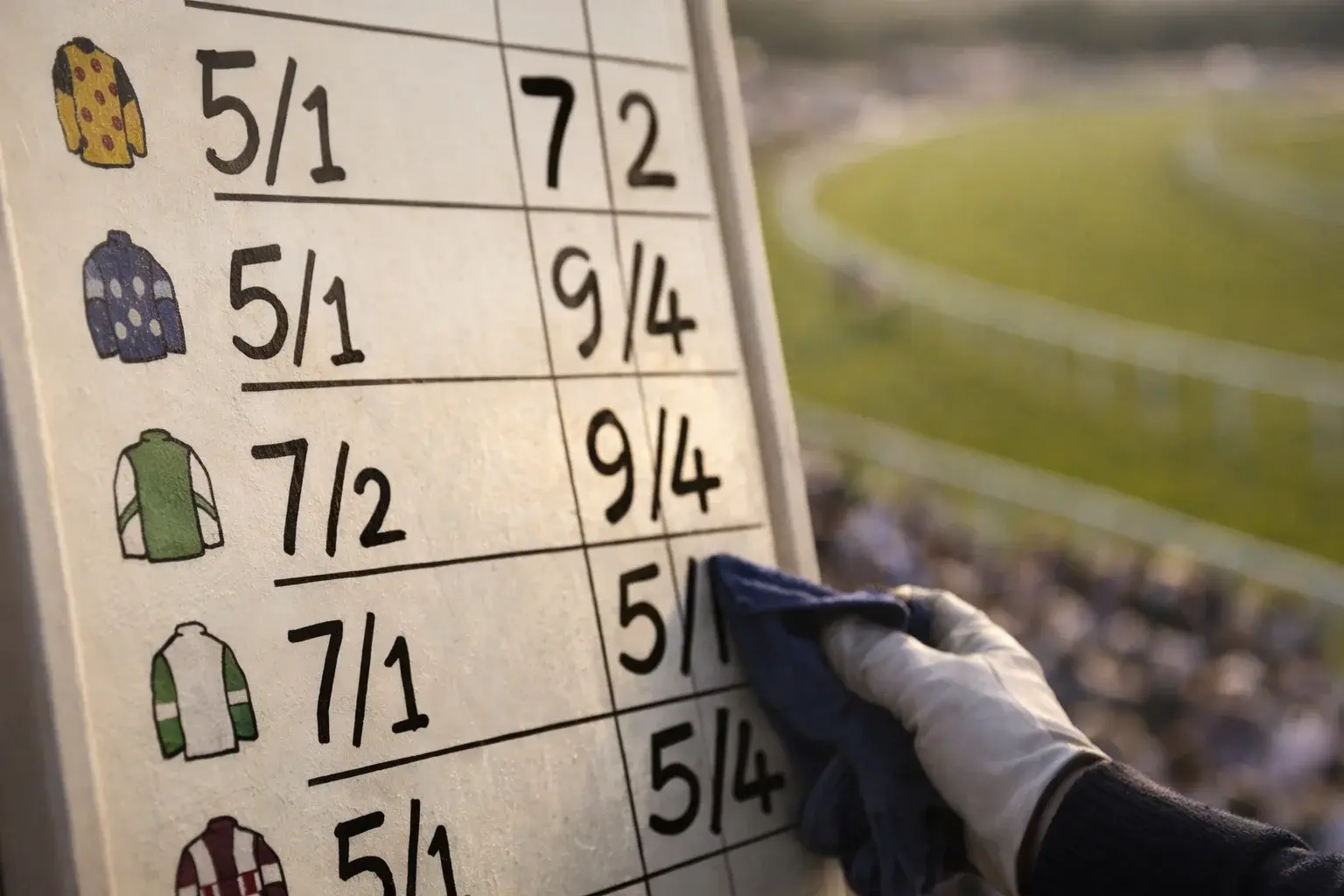
The traditional UK format is fractional odds. A horse at 5/1 returns £5 profit for every £1 staked, plus your stake back — so £10 at 5/1 returns £60 total. The first number is what you win, the second is what you risk. When the first number is smaller — 1/2, for example — the horse is "odds-on," meaning the market considers it more likely to win than lose.
Decimal odds express the total return per unit staked. A horse at 6.0 decimal returns £6 for every £1 — equivalent to 5/1 fractional. The conversion is simple: decimal odds = (numerator / denominator) + 1. Decimal pricing is standard on exchanges and increasingly offered by bookmakers alongside fractional displays, particularly for international races. Many experienced punters prefer decimal because it makes comparison and calculation faster, especially for multiples.
The relationship between odds and probability is direct. Implied probability tells you what the odds assume about a horse's chance of winning. For fractional odds: probability = denominator / (numerator + denominator). A 3/1 shot implies a 25% chance. For decimal odds, divide 1 by the decimal: 1 / 4.0 = 25%. This tells you what the market believes, which gives you a benchmark against which to measure your own assessment.
Converting odds to implied probability
Fractional: 9/2 → 2 / (9 + 2) = 2 / 11 = 18.2%
Decimal: 5.50 → 1 / 5.50 = 18.2%
If you believe the horse's true chance is closer to 25%, you have a potential value bet — the market is underestimating the horse.
One concept that deserves attention even in an overview is the overround. If you add up the implied probabilities of every runner in a race, the total will exceed 100% — often by 10 to 20 percentage points for a typical UK race. That excess is the bookmaker's margin, and it is the structural reason why backing every horse in a race guarantees a loss for the bettor. The overround varies by bookmaker, by race, and by time of day, and it is one of the clearest indicators of whether you are getting a fair deal or a compressed one. Understanding it separates casual punters from those who treat betting as a discipline.
Bet Types at a Glance: Win, Each-Way, Multiples, and More
The range of bet types available on a single horse race is wider than most newcomers expect. Each structure carries a different risk profile and a different relationship with the form data behind your selection.
Win bets are the simplest: you back a horse to finish first, and if it does, you collect your stake multiplied by the odds. If it finishes anywhere else, you lose your stake. A place bet works similarly but pays out if the horse finishes in the top two, three, or four positions, depending on the number of runners and the race type. Place odds are a fraction of the win odds — usually one quarter or one fifth.
Each-way betting is arguably the most popular structure in British horse racing. An each-way bet is two bets in one: a win bet and a place bet, at equal stakes. If your horse wins, both parts pay out. If it places but does not win, you lose the win part but collect on the place part. The place terms depend on the number of runners: in races with eight or more runners, bookmakers typically pay one quarter of the win odds for the first three places; in handicaps with 16 or more runners, the terms often extend to four places at one fifth of the win odds. Each-way is particularly useful in competitive handicaps where you rate a horse highly but recognise it may not win outright. The trade-off is cost — you are staking double.
Forecast and tricast bets require you to predict the first two or first three finishers in exact order. A straight forecast names the winner and the second-placed horse specifically; a reverse forecast covers both possible orderings (and costs double). Tricasts work the same way but for three horses. The returns can be substantial — Computer Straight Forecast dividends of 50/1 or higher are not uncommon in large fields — but the difficulty scales sharply with the number of runners.
Doubles, trebles, and accumulators combine selections from multiple races into a single bet. The winnings from the first leg roll onto the second, from the second to the third, and so on. The appeal is obvious: a four-fold accumulator at modest individual prices can produce an eye-catching return. The risk is equally obvious — all legs must win, and the probability of four independent outcomes all landing in your favour diminishes rapidly. A four-fold accumulator of market favourites, each with a 33% win probability, has roughly a one-in-eighty chance of paying out.
System bets — Trixie, Yankee, Lucky 15, Heinz — provide partial insurance by covering every combination of doubles, trebles, and accumulators within a set of selections. A Lucky 15 covers four selections across 15 bets (four singles, six doubles, four trebles, one four-fold), so a single winner still produces a return. The protection comes at a price: a £1 Lucky 15 costs £15. System bets reduce variance at the expense of total return.
Match the bet type to the situation: win bets for strong convictions in small fields; each-way for competitive handicaps; accumulators only when you understand the compounding risk; system bets when you want to stay in the game across multiple races.
TurfData · Independent Analysis
Each-Way Value & Overround Calculator
Margin removed evenly, so every runner carries the same win-part edge — any difference between runners comes from the place part.
Book overround
–
–
Runner-by-runner
Place % is the modelled chance of finishing in the paid places. E/W edge is the return on a £1 each-way bet.
Total returned
–
–
Model output based on the prices you enter — not a prediction and not a tip. 18+. Gambling involves risk; never stake more than you can afford to lose. National Gambling Helpline: 0808 8020 133.
Ante-Post and In-Play Betting — Timing Your Wagers
When you place your bet matters almost as much as what you bet on. The two extremes of timing — ante-post and in-play — each carry distinctive advantages and risks, and confusing the two is a reliable way to erode your bankroll.
Ante-post betting means placing a wager days, weeks, or even months before a race. The incentive is price: ante-post odds are almost always more generous than the Starting Price because they factor in the uncertainty of whether a horse will actually run. That is also the catch. If your selection is withdrawn — through injury, a change of plan by connections, or unfavourable ground conditions — most ante-post bets are settled as losers. There is no refund unless the bookmaker specifically offers a "Non-Runner No Bet" (NRNB) market, and NRNB prices are typically shorter than true ante-post prices precisely because they remove that risk. The discipline of ante-post betting is knowing which horses are likely to stand their ground and which are at the mercy of trainers who keep multiple options open until declaration stage.
The sweet spot for ante-post value tends to be two to four weeks before a major festival, when the field is taking shape but the market has not yet compressed to reflect confirmed runners. The biggest price movements often occur after a key trial race or significant news from the training gallops.
In-play betting sits at the opposite end of the spectrum. Here, wagers are struck while the race is in progress, with odds updating in real time as horses jump or pass markers on the flat. Exchange platforms like Betfair dominate the in-play racing market because their peer-to-peer model allows prices to be generated by other bettors rather than by a bookmaker's algorithm. Some traditional bookmakers also offer in-play racing markets, though typically with more restricted stakes and a narrower range of bet types.
The practical challenge of in-play racing is speed. A jumps race lasting three or four minutes compresses decision-making into moments, and the video feed you are watching may be delayed by several seconds — enough for prices to move before you can react. Flat races, over in under a minute, offer even less time. In-play betting rewards those who know the course and can judge a horse's running style against its proven form. For most recreational bettors, it is an entertainment product rather than a strategic tool — which is fine, as long as you recognise the distinction.
Where to Bet on Horse Racing
Where to Bet: Online Bookmakers vs Betting Shops
The question of where to place your bet is increasingly answered by default: online. But the offline market has not vanished, and understanding what each channel offers — and what it costs you — is part of making informed decisions.
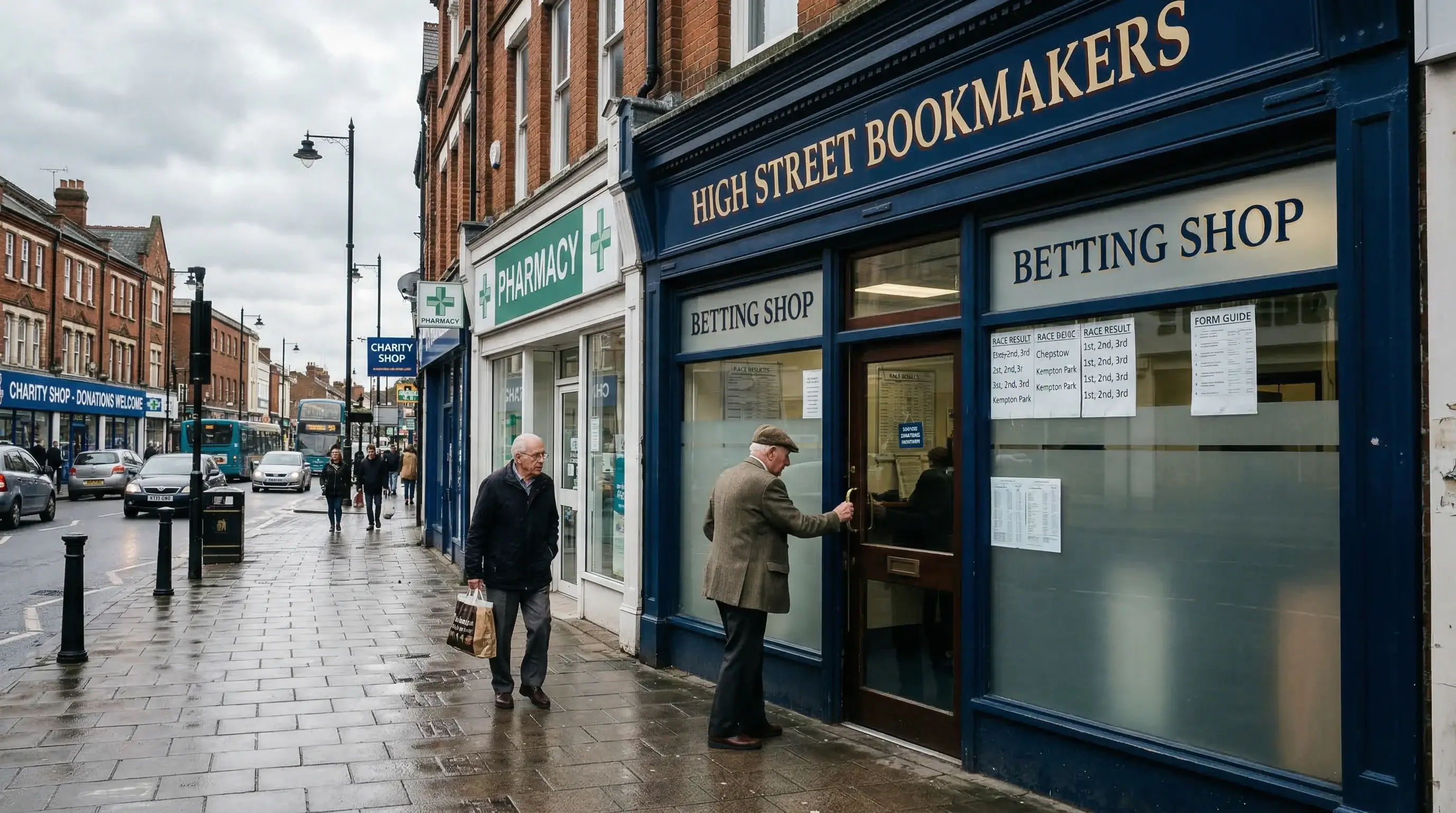
As of March 2025, Britain had 5,825 licensed betting shops, a decline of 1.8% in a single year, according to the Gambling Commission's Industry Statistics. The contraction has been steady for years, accelerated first by the reduction of maximum stakes on fixed-odds betting terminals in 2019, then by the pandemic-driven shift to online platforms, and more recently by rising property costs and changing consumer habits. GGY for licensed betting offices fell 3% year on year in Q4 of FY 2024–2025 to £554 million, with counter-bet volumes dropping 6%, according to the Gambling Commission's market overview.
Online bookmakers, by contrast, command 46% of the total UK gambling market by GGY. Their advantages are familiar: a wider range of markets, better odds on average (because lower overheads allow tighter margins), live streaming, cash-out features, and the convenience of betting from anywhere. The competitive pressure among online operators also means that promotional offers — Best Odds Guaranteed, free bets, enhanced place terms — are more readily available than on the high street.
The case for betting shops is more nuanced than it appears. For horse racing specifically, the shop environment offers real-time access to SIS and Racing UK broadcasts, a social setting that some bettors prefer, and — critically — the ability to place cash bets without the affordability checks and identity verification that online platforms now require. Since the Gambling Commission introduced light-touch financial vulnerability checks for online accounts in 2024, with thresholds lowered further in February 2025, some higher-staking customers have shifted part of their activity back to the counter. That is a niche dynamic, but it illustrates how regulation shapes the channel mix.
On-course betting — placing bets with bookmakers at the racecourse — occupies its own space. The bookmaker ring still operates at every British race meeting, and on-course bookmakers set the official Starting Price. The experience is tactile and fast-paced, dependent on your ability to read market boards and compare prices in real time.
Betting Exchanges and the Tote: Alternatives Worth Knowing
Bookmakers are not the only game in town. Two alternative models — betting exchanges and the Tote — offer structurally different ways to wager on horse racing, and each has situations where it outperforms a traditional bookmaker.
A betting exchange is a peer-to-peer platform where bettors back and lay horses against each other. When you "back" a horse on an exchange, another user is "laying" it — betting that it will not win. The exchange takes a commission on winning bets, typically between 2% and 5%, rather than building a margin into every price. The result is that exchange odds are often slightly better than bookmaker odds on well-traded markets, because the overround is replaced by a flat commission. Betfair is the dominant exchange in the UK, with Smarkets and Betdaq offering alternatives. Exchanges also allow you to lay horses — effectively acting as the bookmaker — which opens up trading strategies that are impossible with a traditional bookie.
The Tote (formerly the Horserace Totalisator Board, now operated commercially) runs parimutuel pools. Instead of taking a fixed price, you contribute your stake to a pool, and the dividend is calculated after the race based on the total pool size and the number of winning tickets. The Tote's products include the Win pool, the Place pool, the Exacta, and the Placepot, which requires you to pick a horse to place in each of the first six races at a meeting. Placepot dividends can be substantial: a £1 stake returning £50 or more is common at meetings with competitive fields. The Tote operates both on course and online, and its parimutuel model means the final dividend is unknown until after the race.
Neither exchanges nor the Tote are inherently "better" than bookmakers. Exchanges reward liquidity-aware bettors who trade positions; the Tote rewards breadth of knowledge across an entire race card. For the majority of horse racing bets, a licensed bookmaker offering Best Odds Guaranteed remains the simplest and most practical choice. But knowing that alternatives exist — and when to use them — is part of a complete approach to UK racing betting.
Reading Form: The Skill That Separates Winners
If odds are the market's opinion, form is the evidence that opinion is based on. Reading form is the single most important analytical skill in horse racing betting, and it is the one that most separates consistent performers from recreational punters who rely on names, jockey colours, or tips.
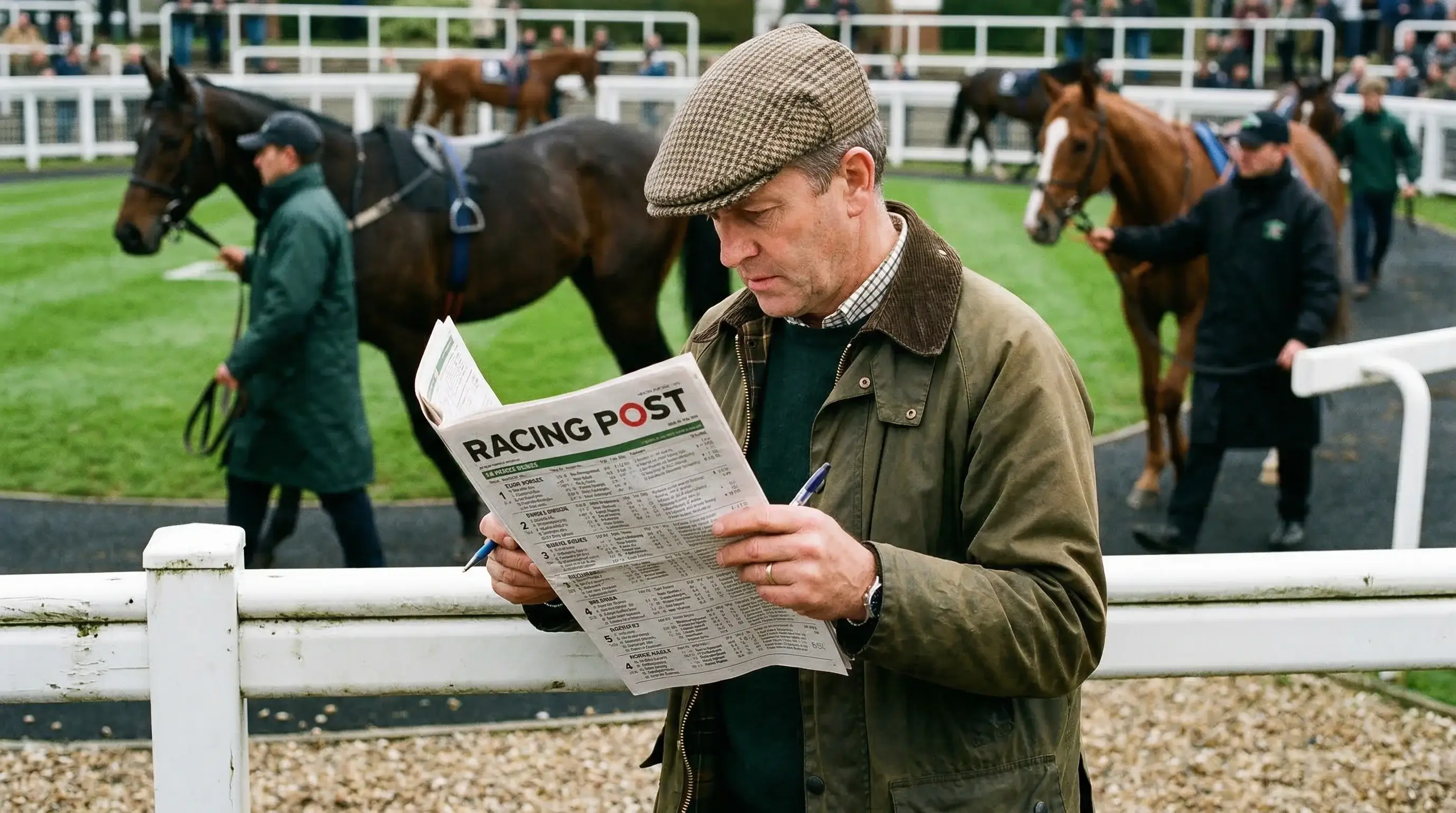
A horse's form figures appear as a sequence of digits and symbols — something like 2333-413. Each number represents the horse's finishing position in its most recent races, read left to right with the most recent last. A dash indicates a break between seasons. Letters carry specific meanings: F for fell, U for unseated rider, P for pulled up, 0 for outside the first nine. The sequence tells a compressed story of recent performance, but it needs context: a horse that finished third in a Group 1 at Ascot is not comparable to one that finished third in a Class 6 seller at Wolverhampton.
That context comes from several sources. The Official Rating (OR) assigned by the BHA handicapper quantifies a horse's ability on a numerical scale. A horse rated 100 is considered roughly 100 lengths better over a typical distance than a horse rated 0. Ratings determine which races a horse can enter and how much weight it must carry in handicaps. Watching for horses that are "well handicapped" — rated lower than their recent form suggests — is a core skill, though one that the market is increasingly efficient at pricing in.
Beyond the numbers, form reading involves assessing ground conditions (some horses are transformed on soft ground; others need it firm), distance (a horse that fades in the final furlong may simply want a shorter trip), course form (some tracks favour front-runners; others suit hold-up horses), and equipment changes (the addition of blinkers, a visor, or a tongue-tie can signal that connections are trying something new to improve performance). Jockey bookings and trainer form add further layers — a top jockey picking up a ride on an unfancied horse can move the market, and trainers often have patterns: some target specific festivals, others peak at particular times of year.
The trap in form reading is information overload. Every race generates dozens of data points, and it is tempting to treat form study as a puzzle with a single correct answer. In practice, form gives you an informed view of probability, not certainty. The goal is to identify horses whose chances are better than the odds suggest — and to let everything else go.
Betting Strategies for Horse Racing
How Often Do Favourites Win? The Data Breakdown
One of the most persistent questions in horse racing is whether backing the favourite is a viable strategy. The short answer is no — not as a blanket approach. The longer answer, supported by data, is more instructive.
Market favourites in British racing win approximately 30–35% of all races, according to analysis by Honest Betting Reviews across datasets spanning two decades. Second favourites win around 20% of the time, and third favourites roughly 12–15%. Taken together, the top three in the betting account for 65–70% of all winners — which means that roughly one in three races is won by a horse outside the first three in the market.
The picture sharpens when you narrow the lens. Odds-on favourites — those priced below 2.0 decimal (evens) — win between 55% and 60% of flat races in the UK, rising to approximately 86% when the price is 1.25 or shorter, according to Matchbook Insights. That sounds like a reliable basis for betting, but the win rate alone does not tell you whether the strategy is profitable. The odds are short precisely because the horse is expected to win, and the margin built into those odds means that even a high strike rate produces a loss over time.
Race type matters significantly. In handicap races, where the BHA assigns weights to equalise the field, odds-on favourites win roughly 53% of the time on the flat. In maiden races — contests for horses that have never won — the figure is closer to 61%. The difference reflects the fundamental nature of handicapping: it is designed to produce close finishes, and it succeeds often enough to make favourites less reliable in that context.
Systematically backing every market favourite across UK racing produces a return on investment of approximately 93p for every £1 staked — a net loss of 7%. For second favourites, the ROI drops to around 88p; for third favourites, about 85p. The bookmaker's margin is built into every price, and no rank of favourite escapes it.
These figures do not mean that favourites are bad bets. They mean that all favourites, taken as a group, are slightly bad bets. Individual favourites can represent excellent value if your form analysis suggests their true chance of winning exceeds what the odds imply. The data is a baseline — it tells you what happens when you apply no skill at all. Beating the baseline is the entire point of studying form, and the fact that the baseline loss is only 7% suggests that the market is efficient but not unbeatable.
Bankroll Management Basics for Horse Racing
The most effective betting strategy in the world is worthless without a bankroll structure to sustain it. Even a profitable bettor with a genuine long-term edge will experience losing runs, and if those runs exhaust the betting bank before the edge expresses itself, the result is the same as having no edge at all.
Start with a figure you can afford to lose entirely. This is not a budgeting platitude — it is a functional requirement. Your bankroll should be separate from your living expenses, set at a level where its complete loss would not affect your financial wellbeing or your emotional state. For most recreational bettors in the UK, a bankroll of £200 to £1,000 is a reasonable starting point, depending on the stakes you intend to use.
The simplest staking method is flat staking: risking the same fixed amount on every bet, typically 1–2% of your total bankroll. On a £500 bank, that means £5–£10 per bet. The advantage of flat staking is its simplicity and its resilience — a losing run of ten bets costs you 10–20% of your bank, not all of it. The disadvantage is that it does not adjust for confidence: a bet you are highly confident about receives the same stake as one that is marginal.
Percentage staking addresses this by tying the stake to the current bankroll size. If your bank grows, your stakes grow; if it shrinks, your stakes shrink. This protects against ruin more effectively than flat staking but introduces a psychological challenge — it feels counterintuitive to reduce your stake after a loss, even though that is precisely the discipline the system demands.
The Kelly Criterion calculates the optimal stake size based on your estimated edge and the odds available. In simplified form: Kelly stake = (edge / odds). If you believe a horse has a 25% chance of winning at odds of 5.0, your edge is (0.25 x 5.0) – 1 = 0.25, and the Kelly stake is 0.25 / (5.0 – 1) = 6.25% of your bankroll. Most experienced bettors use a fraction of Kelly — half or quarter — because the formula assumes your probability estimates are accurate, and they rarely are.
The ROI of blind favourite backing — approximately –7% — provides a useful reference point. If you cannot beat that figure over a meaningful sample of, say, 200 bets, your form analysis is not adding value and it may be time to adjust your approach rather than increase your stakes. Track every bet. Record the selection, the odds, the stake, the result, and the reasoning. Without that data, you are guessing about whether you are getting better — and guessing is the thing bankroll management is designed to eliminate.
Regulation and Safety in UK Horse Racing Betting
UK Gambling Regulation and the Betting Levy
Every legal bookmaker operating in the UK — whether on the high street, online, or at the racecourse — holds a licence issued by the UK Gambling Commission (UKGC). The Commission's remit covers licensing, compliance, enforcement, and player protection. It is the body that sets the conditions under which operators must function, including requirements around age verification, anti-money-laundering procedures, responsible gambling tools, and the segregation of customer funds. If a bookmaker fails to meet these conditions, the UKGC can impose fines, attach additional licence conditions, or revoke the licence entirely.
Horse racing in Britain has a financial relationship with the betting industry that no other sport shares. The Horserace Betting Levy, administered by the Horserace Betting Levy Board (HBLB), requires all bookmakers to pay 10% of their gross profit from bets on British racing back into the sport. That money funds prize money, veterinary science, equine welfare, and integrity services. In FY 2024–2025, the levy yield reached a record £109 million — the fourth consecutive annual increase and the highest figure since the levy system was reformed in 2017, according to the HBLB's Annual Report.
That record, however, sits in the shadow of a proposed tax change. The government's plan to harmonise Remote Gaming Duty — potentially raising it from 15% to approximately 21% for remote betting operators — has provoked alarm across the racing industry. Research commissioned by the BHA and conducted by Development Economics estimated that the tax increase could cost the industry £330 million over five years and put 2,752 jobs at risk in its first year alone.
Brant Dunshea, Chief Executive of the British Horseracing Authority, described the proposal in blunt terms: "This latest tax bombshell from the Government, if followed through, poses one of the gravest risks to horseracing the sport has ever seen. The horseracing industry is already in a precarious financial position, and the latest research provides a much more catastrophic forecast than we first thought." — Brant Dunshea, Chief Executive, British Horseracing Authority.
The HBLB itself has noted that risk-based and other financial checks implemented by betting operators are having a particular effect on higher-staking customers, contributing to lower turnover even as gross profit rises. For bettors, the regulatory landscape means two things: first, your money is better protected with a UKGC-licensed operator than with an unlicensed offshore alternative; second, the checks and limits you encounter — affordability assessments, deposit limits, source-of-funds requests — are a feature of the system, not a malfunction. They exist because the regulator has concluded that the cost of not having them is higher than the inconvenience they cause.
Responsible Gambling: Where to Find Help
No guide to betting should avoid the subject of harm. The Gambling Survey for Great Britain estimated that 2.7% of UK adults scored 8 or above on the Problem Gambling Severity Index in 2024, corresponding to roughly 1.2–1.7 million people. That is a minority of the gambling population, but it is not a trivial one. A further 5.8% of those who had placed a bet in the preceding twelve months scored 1 or above on the PGSI, placing them in the at-risk zone, according to a GambleAware report published in early 2025.
The UK regulatory framework now includes a suite of tools designed to help bettors manage their activity. All UKGC-licensed operators must offer deposit limits, loss limits, session time reminders, cooling-off periods, and self-exclusion. GAMSTOP, the national self-exclusion scheme, allows you to exclude yourself from all licensed online gambling sites in the UK for a minimum of six months. It is free to use and covers every operator registered with the Gambling Commission.
"We have already introduced light-touch financial vulnerability checks on those spending £150 a month, reduced the intensity of all online games by banning autoplay and slowing game speed, and tightened age verification in premises." — Andrew Rhodes, Chief Executive, Gambling Commission.
If you recognise signs of problematic betting behaviour in yourself — chasing losses, betting more than you can afford, borrowing to gamble, lying about how much you spend, or feeling anxious or irritable when you try to stop — the resources below are available confidentially and at no cost:
- GambleAware — information, advice, and support: www.gambleaware.org
- National Gambling Helpline — 0808 8020 133 (freephone, 24 hours)
- GAMSTOP — self-exclusion from all UK-licensed online gambling: www.gamstop.co.uk
Responsible gambling is not a footnote. It is a precondition for treating betting as a sustainable activity rather than a destructive one. Every tool mentioned above exists because enough people needed them — and there is no shame in being one of them.
Are Horse Racing Winnings Taxed in the UK?
This is one of the simplest questions in UK betting, and the answer has been the same since 2001: no, punters do not pay tax on their winnings. The old system, abolished in October 2001 by Chancellor Gordon Brown, required bettors to pay a 9% duty on their stakes or winnings. The current framework places the entire tax burden on the operator, not the customer.
Licensed bookmakers pay Remote Gaming Duty at a rate of 15% on their gross profits from online betting, gaming, and other remote activities. Land-based operators pay General Betting Duty at 15% of gross profits. These taxes are invisible to the bettor — they are factored into the odds and margins rather than deducted from payouts. The practical effect for you is straightforward: if you back a horse at 10/1 and it wins, you receive your full return with no deduction. This applies regardless of the size of the win. There is no threshold above which winnings become taxable, and there is no requirement to declare gambling profits on a self-assessment tax return, provided gambling is not your primary trade or business.
The exception, which affects a very small number of people, concerns professional gamblers whose betting activity constitutes a trade. HMRC's guidance has historically been that gambling winnings are not taxable because gambling is not a trade — the element of chance prevents it from being classified as such. In practice, this means that even highly successful, systematic bettors are not taxed on their profits in the UK, making the country one of the most favourable jurisdictions in the world for serious punters.
Frequently Asked Questions
What is each-way betting and how does it work?
An each-way bet is two bets in one: a win bet and a place bet, both at the same stake. If your horse wins, both parts pay out — the win part at full odds and the place part at a fraction (usually one quarter or one fifth) of the win odds. If the horse places but does not win, you lose the win part but collect on the place part. The number of places paid depends on the field size: races with eight or more runners typically pay three places; handicaps with 16 or more runners often pay four. Because each-way is two bets, a £5 each-way bet costs £10. It is most useful in competitive races where you rate a horse well but acknowledge it may not win outright.
How do I read horse racing odds and a form card?
Fractional odds, the traditional UK format, show profit relative to stake: 5/1 means £5 profit for every £1 bet. Decimal odds show total return: 6.0 means £6 returned for a £1 stake (equivalent to 5/1). To convert fractional to decimal, divide the first number by the second and add one. To calculate implied probability from fractional odds, divide the second number by the sum of both numbers — so 3/1 implies a 25% chance. A form card shows each horse's recent finishing positions (e.g. 2333-413), its Official Rating, the weight it carries, the jockey and trainer, and equipment flags such as blinkers or cheekpieces. Reading form means combining these data points with race conditions — distance, going, class — to assess whether a horse is likely to run to its rating or improve. The numbers are the starting point; context is what makes them useful.
Is horse racing betting profitable and how do I manage my bankroll?
For the vast majority of bettors, horse racing is not a long-term profit source. Systematically backing every market favourite returns approximately 93p for every £1 staked — a net loss of around 7% — which reflects the bookmaker's built-in margin. Beating that baseline requires consistent skill in form analysis, value identification, and discipline. Those who do profit tend to specialise in a particular code, race type, or course, and manage their bankroll with strict rules. The standard recommendation is to risk no more than 1–2% of your total bankroll per bet, keep your bankroll separate from everyday funds, and track every wager. Over a sample of at least 200 bets, you can assess whether your approach is adding value. If you consistently lose more than the 7% baseline, reduce your stakes and reassess before increasing commitment.
