
 Available in US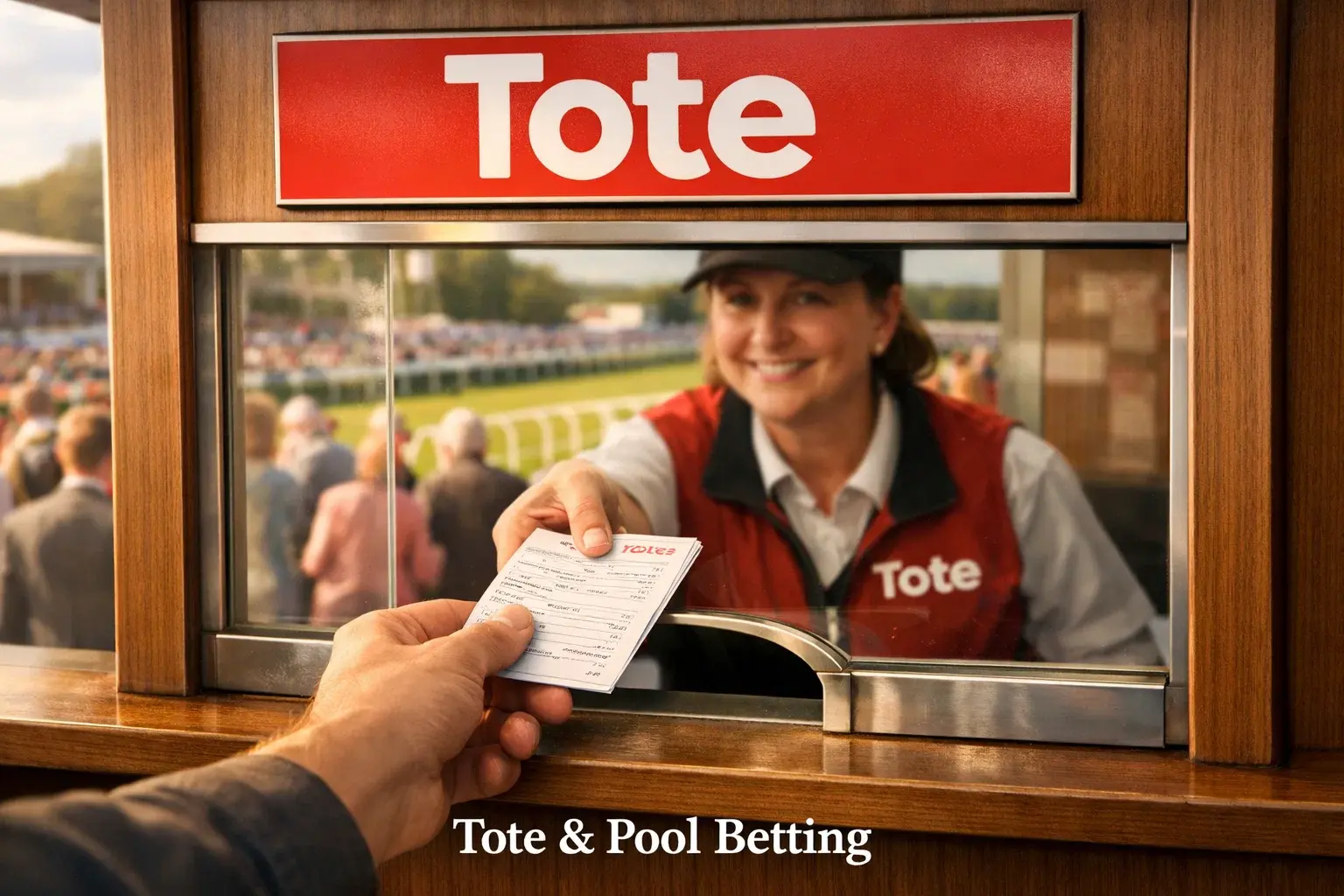
Pool Betting — You Against the Crowd, Not the Bookmaker
Tote betting explained in one sentence: you’re betting into a shared pool with every other punter, not against a bookmaker’s fixed price. The total amount staked on a race is collected, a deduction is made for operating costs and funding, and the remainder is divided among holders of winning tickets. Your payout depends on how many other people picked the same horse — not on odds set by a bookmaker’s trading team.
This parimutuel model has operated in Britain since 1928, and it serves a fundamentally different function from fixed-odds betting. With a bookmaker, you lock in a price the moment you place your bet. With the Tote, the price isn’t finalised until the pool closes, which happens when the race starts. That uncertainty is the trade-off: you might get a better return than the bookmaker offered, or a worse one, and you won’t know until after the result.
The Tote occupies a distinctive position in UK racing infrastructure. While over 5 million people attended British racecourses in 2025 — the first time that figure had been exceeded since 2019 — the Tote remains the most accessible on-course betting option, with a minimum bet of just £2 and acceptance of both cash and card. It’s a logical starting point for racecourse newcomers who want to bet without navigating the bookmaker ring.
How Tote Dividends Are Calculated
The Tote’s payout system works through dividends declared after each race. When you bet with the Tote, you don’t receive fixed odds. Instead, after the race, a dividend is announced for every £1 staked. If the win dividend is declared at £4.20, a £5 bet on the winner returns £21 (£4.20 multiplied by five). Your stake is included in the returned amount, so the profit in this case is £16.
The dividend is calculated by taking the total pool, subtracting the Tote’s deduction (which varies by bet type but typically sits around 13 to 28 per cent), and dividing the remainder among all winning unit stakes. The more people who backed the winner, the smaller the dividend. The fewer who backed it, the larger the payout. This is why the Tote can sometimes pay significantly more than the bookmakers on an outsider — if the crowd backed the favourite and a longer-priced horse wins, the pool is split among fewer winning tickets.
Conversely, on a well-backed favourite, the Tote dividend is often lower than the bookmaker’s starting price. If everyone in the pool has backed the same horse, the pie gets sliced into tiny portions. This dynamic makes the Tote most interesting in competitive races where the betting is spread across the field, and least attractive in races with a dominant, short-priced favourite.
Dividends are declared “to a £1 stake.” The results board at the racecourse and online displays show figures like “Win: £6.30” or “Place: £2.10.” Multiply these by your stake in pounds to find your total return. No mental arithmetic with fractions required — which is part of the Tote’s appeal to people who find traditional odds formats confusing.
Placepot, Quadpot, Exacta, Trifecta
Beyond simple win and place pools, the Tote offers several multi-race and within-race bet types that have no direct equivalent in fixed-odds bookmaking. These pool bets can produce outsized returns from small stakes, which is why they have a loyal following among regular racegoers.
The Placepot is the most popular and the most social. It requires you to select a horse to place (finish in the frame) in each of the first six races at a meeting. All six selections must place for the bet to win. The minimum unit stake is £1, and the pool is shared among all winning unit stakes. Placepot dividends vary wildly — a routine day at a minor meeting might pay £30 to a £1 stake, while a turbulent day at a major festival can return hundreds or even thousands. The bet rewards consistent placing rather than picking winners, which makes it more forgiving than an accumulator.
The Quadpot works on the same principle but covers races three through six at the meeting — four races instead of six. It’s easier to land, so the dividends tend to be smaller, but it’s a good alternative if you’ve arrived late or missed the first couple of races.
The Exacta asks you to predict the first two finishers in a single race in the correct order. It’s a forecast bet, essentially, but paid through the pool rather than at a Computer Straight Forecast price. You can also box your selections (backing them in any order), which costs more but doubles your coverage. Exacta dividends in competitive handicaps can be substantial when the first two home are both unconsidered by the majority of the pool.
The Trifecta extends this to the first three finishers in exact order. The permutations increase rapidly with more selections, and so does the cost, but the potential returns dwarf most other bet types. A £1 Trifecta in a sixteen-runner handicap where outsiders fill the first three places can return four or five figures. It’s a lottery ticket with the veneer of skill — and that combination is what keeps people coming back.
Tote vs Bookmaker Odds — When the Pool Pays More
The common wisdom is that bookmakers usually offer better value than the Tote, and in aggregate that’s true. Bookmakers compete with each other, which tends to keep margins tighter, and they’re especially competitive on favourites and well-backed runners. The Tote deduction is a fixed drag on every pool, regardless of the result.
But the Tote wins on specific occasions, and experienced racegoers know how to spot them. The most common scenario is a race won by an outsider that few Tote bettors backed. Because the pool is split among fewer winners, the dividend can exceed the bookmaker SP — sometimes significantly. Races with large fields, even money distribution across the runners, and a result that defies public expectation are where the Tote shines.
David Armstrong, then Chief Executive of the Racecourse Association, captured the broader competitive context when he noted that “while sports attendances across major events have been growing, it is not the case in the leisure market” — with 67 per cent of British consumers actively reducing spending on dining out, according to a KPMG-audited report. Racecourses are competing for discretionary spending, and the Tote’s low minimum stakes and simple structure help lower the barrier to entry for visitors who might not otherwise bet.
The Tote also has structural advantages on certain bet types. Placepot and Quadpot dividends have no direct bookmaker equivalent, and the Tote Exacta sometimes pays more than the Computer Straight Forecast because the pools are driven by different customer bases with different biases. Checking both the Tote dividend and the CSF after a forecast result is a useful habit — the discrepancy reveals how differently the two systems value the same outcome.
Betting with the Tote Online and On Course
On course, the Tote operates through its own dedicated windows and terminals at every British racecourse. The service is run through Britbet, a company owned by the Jockey Club and the majority of other racecourses. By choosing to bet with the Tote on course, a portion of the pool deduction feeds back into racing — prize money, integrity, and welfare — which gives it an ethical dimension that bookmaker bets don’t automatically carry.
Online, the Tote is available through its own website and app, tote.co.uk. The interface offers the same pool bet types as on course, plus some additional features like Tote+ (which guarantees at least the SP on win bets) and Tote Ten to Follow, a season-long competition. Placing a Tote bet online works much like any bookmaker bet: select the race, choose your horse, pick the bet type, enter your stake, and confirm.
The main limitation of online Tote betting is liquidity. Small or midweek meetings sometimes have thin pools, which means dividends can be skewed by one or two large bets. At major meetings — Cheltenham, Royal Ascot, the Grand National — pools are deep enough for dividends to reflect genuine market sentiment. As a rule of thumb, if the meeting is televised and attracting decent on-course crowds, the pool will be robust enough for meaningful Tote betting. The Racecourse Association’s data showing that the number of licensed betting shops fell to 5,825 in 2025 suggests that the on-course experience, Tote included, is becoming a relatively more important touchpoint for the sport.
Tote and Pool Betting — More on this topic at betting on horse racing.
See also Seasonality in Horse Racing Betting.
