
 Available in US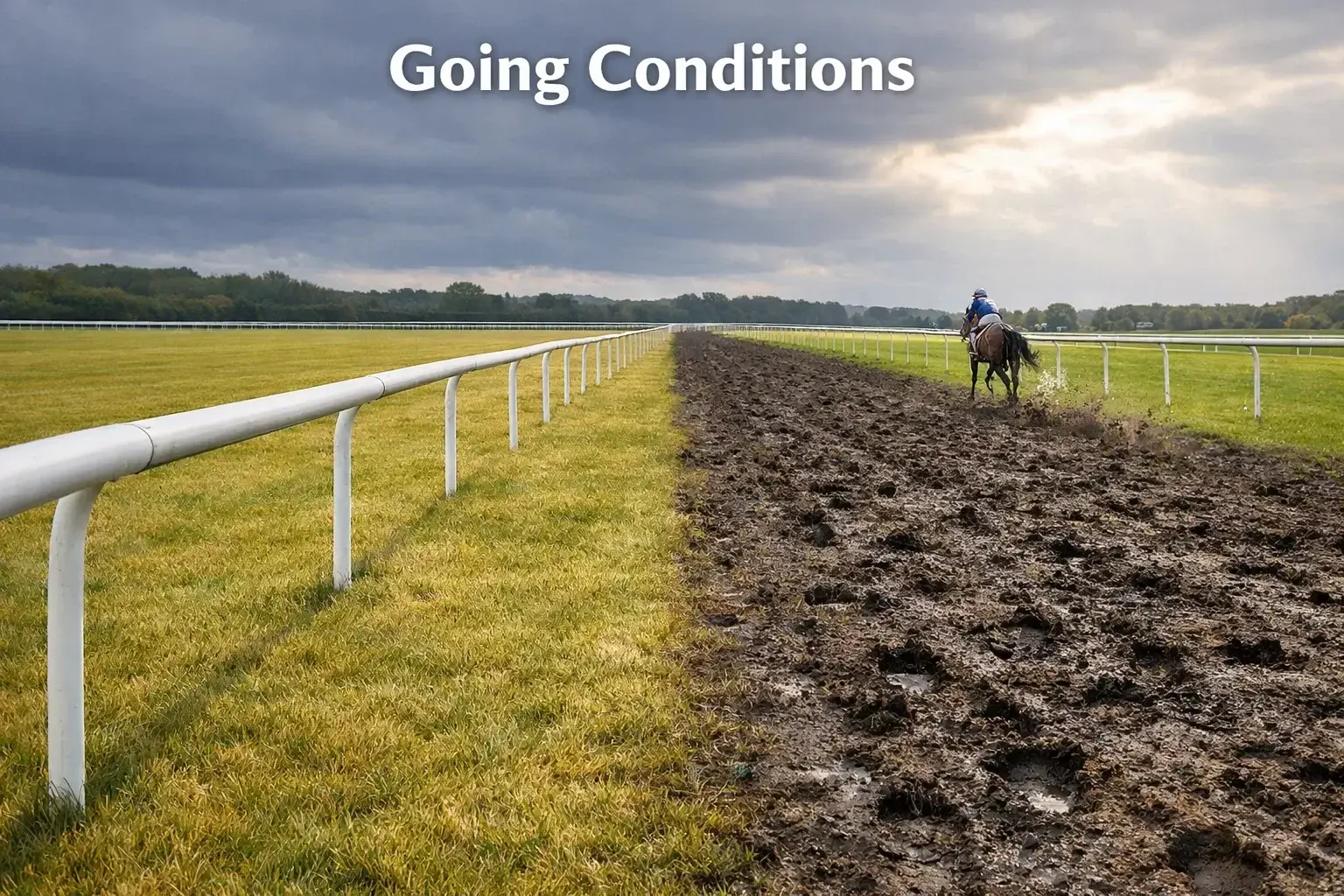
Ground Kills More Bets Than Bad Luck
Going conditions — the state of the racing surface — are the single most underweighted factor in casual horse racing betting. A horse that looked invincible on good ground can look ordinary on heavy, and vice versa. Trainers know this. Jockeys know this. Bookmakers price it in. Yet a surprising number of bettors treat the going as an afterthought, if they consider it at all.
The going affects everything: race times, tactical approaches, stamina demands, and the viability of horses at every position in the market. It dictates whether front-runners can dominate on a fast surface or get dragged into a war of attrition on soft ground. It determines whether a horse’s proven form is relevant to today’s race or belongs to a different set of conditions entirely. In a sport where the average Flat Premier raceday field contains nearly eleven runners competing for the same prize, the going is often what separates the shortlist from the also-rans.
The Going Scale from Hard to Heavy
British racecourses use a standardised descriptive scale for going, running from the fastest surface to the slowest. On turf, the scale reads: hard, firm, good to firm, good, good to soft, soft, soft to heavy, heavy. On all-weather surfaces, which use artificial materials like polytrack or fibresand, the scale is simpler: fast, standard to fast, standard, standard to slow, slow.
Hard ground is rare in Britain and generally unwelcome. It puts significant stress on horses’ legs and joints, and most trainers will withdraw their runners if the ground is officially described as hard. Firm ground is fast and suits speed-oriented horses, particularly in sprint races on the Flat. It favours horses with a quick action — those that skim over the surface rather than digging in.
Good to firm and good are considered the default conditions for quality Flat racing. Most horses handle this range without difficulty, and form achieved on good ground is generally the most transferable. The distinction between good to firm and good can still be meaningful — a horse with proven form on good to firm might find the extra give in good ground uncomfortable enough to underperform by a length or two.
Good to soft is the transition zone. It favours horses that stay well and have the strength to cope with a surface that’s beginning to hold. Soft ground is genuinely testing — race times increase noticeably, the stamina demands rise, and horses that lack the constitution for it will tire in the final furlong. Heavy ground is an endurance test. Races on heavy ground are often unrecognisable from the same event on a different day, with outsiders running into the places because the conditions negate the speed advantage of more talented runners.
For National Hunt racing, the scale carries even greater significance. Steeplechase fences demand good jumping technique, and heavy ground makes the landing side of each obstacle more treacherous. Falls are more common on extremes of going — very firm ground offers no cushion on landing, while heavy ground saps a horse’s energy to the point where tired jumping causes errors.
How the Going Stick Works
The going used to be assessed by the clerk of the course walking the track and using a combination of experience, heel impression, and common sense. That’s still part of the process, but since 2007 British racecourses have also used a mechanical device called the going stick to provide an objective measurement.
The going stick is pushed into the turf and measures the resistance of the ground. It produces a numerical reading — typically from around 2.0 (very soft) to 14.0 (very firm) — which translates to the descriptive scale. A reading of roughly 7.0 to 8.0 corresponds to good ground, while anything below 5.0 is getting into soft or heavy territory. Above 10.0, the ground is firm.
Readings are taken at multiple points around the course and reported as an average, often with separate figures for the straight course and the round course. This matters because different parts of a track can ride differently — the home straight, which gets the most traffic, may be more worn and slightly softer than the back stretch. When a clerk of the course reports “good, good to soft in places,” they’re acknowledging this variability.
For bettors, the going stick provides a finer grain of information than the published description alone. A course described as good with a stick reading of 7.2 is materially different from one described as good with a reading of 8.8 — the first is on the easy side of good, the second is borderline good to firm. Bookmakers factor these nuances into their pricing, and punters who track the readings can spot situations where a horse’s going preference aligns more closely than the headline description suggests.
Reading a Horse’s Going Preference in Form
Every racehorse has a going preference, though some are more pronounced than others. The form card tells you where a horse has run and on what ground, and from that data you can build a picture of which conditions suit it best.
The most direct evidence is winning form. A horse that has won twice on soft ground and never on good to firm is telling you something clear. But winning form isn’t the only data point — placed efforts and the margin of defeat matter too. A horse that finishes a close second on heavy ground and a distant fifth on firm ground has an obvious preference even if both results are technically losing form.
Pedigree offers supplementary clues. Certain sires are known to transmit a preference for specific ground conditions. A horse by a proven soft-ground sire that’s making its debut on heavy ground is a more credible contender than one by a speed-oriented stallion tackling the same conditions for the first time. Breeding doesn’t guarantee anything, but in the absence of direct experience, it’s the next best thing.
Watch for trainers withdrawing horses on the morning of a race due to going concerns. These withdrawals — which are listed in the non-runner announcements — are direct signals from the people who know the horse best. If a trainer pulls a horse from a valuable race because the ground has turned soft overnight, that horse’s form on soft ground (or lack of it) is likely unreliable. The number of Jump horses in training has dropped by approximately 6.5 per cent in the year to September 2024, according to BHA figures, and ground-related withdrawals contribute to thinner fields during wet spells.
Going and Its Outsized Impact on Jumps Racing
Everything discussed so far applies to both Flat and National Hunt racing, but the going carries disproportionate weight in the jumping codes. The reasons are physical, tactical, and seasonal.
Physically, Jump horses carry more weight over longer distances and must navigate obstacles. Soft or heavy ground adds substantially to the energy expenditure, turning a three-mile chase from a test of ability into a survival exercise. Horses that lack the stamina to cope simply stop in the final half mile, regardless of how talented they are on a better surface. This is why some top-class jumpers have career records littered with brilliance on good ground and failure on soft — their talent can’t overcome the energy drain.
Tactically, soft ground changes how races are run. Front-runners who enjoy dictating the pace on good ground find themselves working harder to maintain position through holding conditions. The closers — horses that sit off the pace and finish strongly — benefit because the leaders tire sooner. This shift in race dynamics means that the same field, on different ground, might produce completely different results.
Seasonally, the Jump programme runs from October to April, covering the wettest months of the British calendar. Extended wet periods can leave courses waterlogged for weeks, leading to a string of heavy-ground fixtures. The first quarter of 2024 offered a vivid example: 78 per cent of Jump fixtures were run on soft or heavy going, according to BHA monthly data. Horses that need better ground simply didn’t have opportunities, and those that thrive on testing conditions had an outsized advantage.
For bettors, the lesson is straightforward. Before studying form, checking the going, and cross-referencing it with each runner’s preferences, is not optional. It’s the first filter. Get it wrong and the rest of your analysis is built on a false premise. Get it right and you’ve already eliminated a significant portion of the field from consideration, leaving fewer horses to assess in greater depth — which is precisely how you narrow a field of eleven down to the two or three that warrant your money.
Going Conditions in Horse Racing — More on this topic at betting on horse racing.
See also Flat Racing vs National Hunt.
