
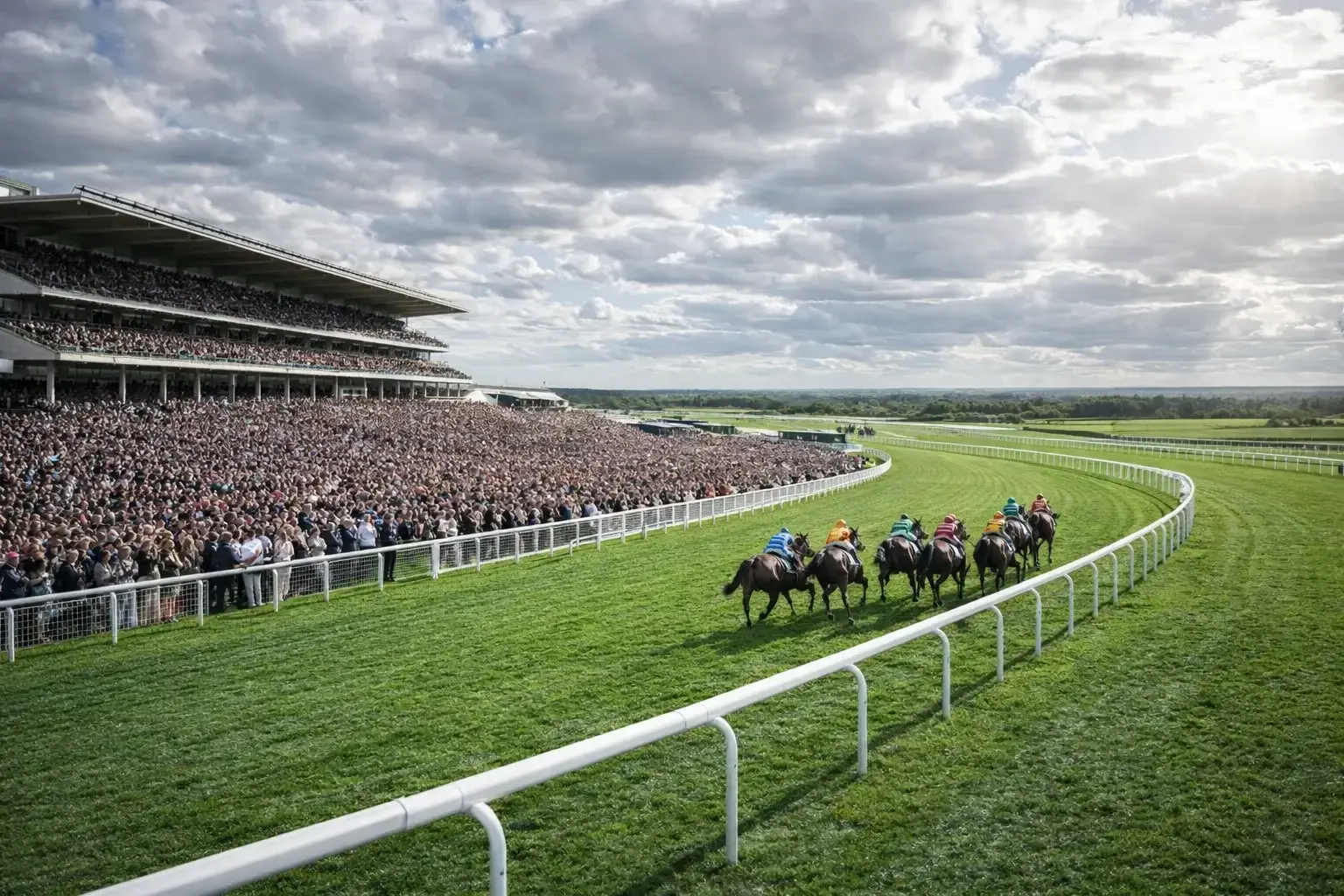
The UK Racing Year Is a 12-Month Betting Opportunity
British horse racing does not have an off-season in any meaningful sense. There is turf Flat racing from April to October, National Hunt over jumps from October through April, and all-weather Flat racing running year-round at tracks like Kempton, Lingfield, Wolverhampton, and Newcastle. On any given week, there are meetings to study and bets to be placed. But the quality, the public attention, and the betting volumes are not distributed evenly. They cluster around a handful of festivals and flagship fixtures that define the racing calendar — and understanding that calendar is essential for anyone who wants to bet with awareness of what the market looks like at different points in the year.
Data from the Gambling Commission’s GSGB survey reveals just how sharply participation in horse racing betting fluctuates with the calendar. In the first wave of the 2025 survey (January to April), 4% of adults reported betting on horse racing in the previous four weeks. By the second wave (April to July), covering the Cheltenham Festival, the Grand National, the Guineas, and Royal Ascot, that figure had jumped to 7%. The seasonal spike is driven by the concentration of high-profile events — and it is during these peaks that the betting market is at its most active, most liquid, and most competitive.
What follows is a month-by-month journey through the major fixtures, from Cheltenham in March to the King George on Boxing Day. For each event, the focus is on what makes it distinctive as a betting proposition — the type of racing, the scale of the fields, the market dynamics, and the factors that separate informed punters from the casual crowd. Understanding the rhythm of the year helps you plan where to invest your time and your bankroll. Not every meeting deserves equal attention — and knowing which fixtures offer the best opportunities is itself a form of edge.
Cheltenham Festival — Jump Racing’s Crown Jewel
The Cheltenham Festival, held over four days in mid-March, is the single most important event in the National Hunt calendar. Twenty-eight races across four days, including the Champion Hurdle, the Queen Mother Champion Chase, the Stayers’ Hurdle, and the Cheltenham Gold Cup. For jump racing, Cheltenham is what Wimbledon is to tennis — the definitive test of quality, the place where reputations are made or broken, and the event that generates more ante-post betting activity than any other fixture in British racing.
Total prize money across UK racing reached £153 million in the first nine months of 2025, according to the BHA’s Q3 Racing Report, with Cheltenham accounting for a significant share of that figure. The Festival’s economic weight extends well beyond prize money, though. It drives betting turnover, media coverage, and racecourse attendance in a way that no other National Hunt fixture can match.
“The last two months, February and March 2025, saw bookmakers’ gross profits well above recent norms, with March’s outturn reflecting particularly bookmaker-friendly results at the Cheltenham Festival. This is not the first time in recent years that Cheltenham has had a significant impact on yield, a reflection of the essential unpredictability of the sport” — Alan Delmonte, Chief Executive, HBLB. That unpredictability is central to the betting experience. Cheltenham’s famously undulating course, with its uphill finish and often testing ground, produces results that confound the market more frequently than most major fixtures. Favourites are beaten regularly. Upsets are the norm rather than the exception.
For bettors, Cheltenham demands a particular approach. The ante-post market opens months in advance, and the best prices are almost always available early — before the public piles in and shortens the odds. However, ante-post carries risk: injuries, defections, and ground changes can render a bet worthless with no refund. The festival’s large fields (particularly in the handicap events on the Wednesday and Thursday) make each-way betting essential for anyone targeting runners outside the top two or three in the market. Trainer form at the festival is a critical angle — certain yards, notably the leading Irish operations, dominate specific races year after year, and their entries carry an almost automatic premium in the market.
The sheer volume of informed analysis published in the weeks before Cheltenham makes it both the best-researched and the most efficiently priced meeting of the year. Finding value requires looking beyond the obvious narratives — the hyped-up unbeaten novice, the sentimental returning champion — and identifying horses whose form, conditions, and connections suggest a genuine chance at odds that reflect the uncertainty of the event rather than the certainty of the hype. Ground conditions at Cheltenham, which can change dramatically from Monday to Friday of the Festival depending on rainfall, add another variable that reshapes the market in real time and rewards punters who monitor conditions right up to the moment the first race goes off.
Grand National — The Nation’s Race
The Grand National at Aintree, held in early April, occupies a unique place in British sporting culture. It is the one horse race that transcends the racing community: office sweepstakes, family gatherings around the television, and bets from people who may not wager on any other event all year. For a betting guide, that matters — because the Grand National’s peculiarities as a race directly shape the betting approach required.
The race itself is a handicap steeplechase over approximately four miles and two-and-a-half furlongs, featuring 30 fences (including the famous Becher’s Brook, The Chair, and Canal Turn) and a maximum field of 40 runners. The distance, the obstacles, and the number of participants make it the most attritional race in the calendar. Horses fall, are pulled up, or refuse at a rate far higher than in standard steeplechases. Finishing the course is an achievement in itself — and for bettors, this means the each-way market is often more relevant than the win market.
Attendance data from the Racecourse Association’s 2025 report showed that the Grand National Festival saw a 4.1% year-on-year increase in attendance. The combination of sporting spectacle, social event, and one of the biggest betting heats of the year continues to draw crowds — and that public interest translates into deep, liquid betting markets with some of the widest price discrepancies between bookmakers of any fixture.
Key form factors for the Grand National are well-documented but frequently ignored by the casual once-a-year bettor. Age matters: winners are overwhelmingly aged between 8 and 11. Weight matters: no horse has carried more than 11st 9lb to victory since Red Rum won under 12st in 1974, and most recent winners have carried well under 11st. Previous course experience matters: horses that have run at Aintree before — ideally over the Grand National fences rather than just the Mildmay course — have a significant statistical advantage. And stamina is paramount: a horse that has won or placed over three miles or more in a competitive steeplechase is a far more credible National contender than one stepping up from shorter trips, regardless of how talented it may be.
With 40 runners, bookmakers pay four places each-way at a quarter the odds. Some extend this to five or six places as a promotional offer during National week. Backing at generous place terms on a horse with a proven course record and a manageable weight is, statistically, the most sensible approach for most punters. The once-a-year bettor may back a name they like. The informed bettor backs a profile.
The Grand National also represents one of the clearest examples of market inefficiency in the calendar. The volume of uninformed money entering the market — office sweepstakes, novelty bets, names picked from a hat — inflates the prices of some runners and compresses others. For punters who have done their homework, the National’s recreational money creates genuine opportunities that do not exist at meetings where the market is dominated by professionals and informed regulars.
The Guineas and the Start of the Flat Season
The turf Flat season begins in earnest in late April and early May, with the first Classics of the year staged at Newmarket. The 2,000 Guineas (for colts) and the 1,000 Guineas (for fillies) are run over the Rowley Mile — a straight course that places a premium on raw speed and tactical awareness. These races represent the first major test of the three-year-old generation, and the results shape the Classic picture for the rest of the season, influencing ante-post markets for the Derby, the Oaks, and beyond.
Betting on the Guineas races requires a different mindset from the jumps. You are dealing with lightly raced three-year-olds, many of whom have run only three or four times in their careers. Form samples are small, and improvement from two to three is often rapid and unpredictable. The trainers with the strongest juvenile records — those who have brought the best horses through the previous season’s two-year-old programme — tend to dominate, and the market prices this expectation accordingly. Finding value often means looking at late-developing types who ran once or twice at two and showed enough promise to suggest that a step up to a mile at three could unlock a new level of performance.
The Guineas Festival at Newmarket also saw a notable boost in interest: the Racecourse Association reported a 13.2% year-on-year attendance increase at the 2025 edition, suggesting that the early Flat fixtures are attracting a growing audience. For bettors, the start of the Flat season also marks a shift in the types of data that matter. Going preferences are less established for young horses; draw statistics become critical on certain courses; and the all-weather form that many of these horses accumulated over winter provides a useful but imperfect guide to how they will perform on turf.
The Flat season’s arrival also brings a change in market dynamics. All-weather racing, which fills the winter calendar, gives way to turf — and the shift often catches out bettors who have been backing horses based purely on their synthetic surface form. A horse that cruised home on the Polytrack at Kempton may struggle entirely on soft turf at York. The transition period in April and May is ripe with form traps, but also with opportunities for anyone who pays attention to surface preferences.
Royal Ascot — Five Days of Elite Flat Racing
Royal Ascot in mid-June is the Flat season’s showpiece — five days of top-class racing, featuring Group 1 contests that attract the best horses from Britain, Ireland, France, Australia, Japan, and the United States. The Gold Cup, the Queen Anne Stakes, the Diamond Jubilee, the Prince of Wales’s Stakes — these are races that determine end-of-season championship honours and influence the breeding industry’s most significant commercial decisions.
For bettors, Royal Ascot presents a fascinating paradox. The quality of the fields is the highest of the year, the data available on each runner is extensive, and the analytical coverage in the specialist press is exhaustive. Yet the results remain difficult to predict. Large fields — particularly in the handicaps on the Wednesday and Saturday — combined with genuine international competition mean that the depth of talent in each race is greater than at almost any other meeting. Ascot’s attendance figures reflect the event’s stature: the Racecourse Association reported a 4.8% increase in attendance at Royal Ascot 2025, continuing an upward trend.
The straight course at Ascot, used for races up to a mile, is one of the widest and fairest in the country, but draw biases can still emerge depending on the going and whether the ground is fresh or worn. The round course features a stiff uphill finish that catches out horses lacking true stamina at the distance. These track-specific factors are well-known to experienced punters but often overlooked by the wave of occasional bettors attracted by the glamour of the event.
Ante-post markets for Royal Ascot open weeks in advance, and the early prices can offer genuine value — particularly on horses from smaller yards or those with less-publicised form lines. As the week approaches and tips proliferate through social media and the racing press, prices on the popular fancies compress rapidly. The best value at Ascot is usually found either very early (before the market fully forms) or very late (when a specific going change or confirmed rider booking creates a new angle that the ante-post market did not anticipate).
Royal Ascot’s combination of elite racing, massive betting volumes, and competitive fields makes it the defining week of the Flat calendar. It is also, for many professional bettors, one of the most profitable — precisely because the influx of recreational money distorts the market and creates value that does not exist at quieter fixtures.
Summer and Autumn — Goodwood, York, St Leger
The months from July to September are the heart of the Flat turf season, with flagship meetings at Goodwood, York, and Doncaster anchoring a packed schedule. The Qatar Goodwood Festival (late July to early August) is nicknamed “Glorious Goodwood” for good reason — five days of high-quality racing on one of the most scenic courses in the country, set in the South Downs. The Sussex Stakes, the Nassau Stakes, and the Goodwood Cup are among the highlights. For bettors, Goodwood’s quirky, undulating track produces results that favour course specialists and ground-sensitive horses — making it a fixture where homework on track form pays disproportionate dividends.
York’s Ebor Festival in August is arguably the strongest all-round Flat meeting outside Royal Ascot. The Juddmonte International, the Yorkshire Oaks, and the Nunthorpe Stakes are Group 1 contests of the highest calibre. The Ebor Handicap itself — one of Europe’s most valuable flat handicaps — attracts large fields and enormous betting interest. York’s wide, galloping track is one of the fairest in Britain, and the form that emerges from the Ebor Festival is among the most reliable of the season — horses that perform well here tend to confirm the form later.
Doncaster’s St Leger meeting in September brings the Classic season towards its conclusion with the oldest Classic in the calendar — the St Leger, run over a mile and six furlongs and a test of genuine stamina for three-year-olds. The St Leger has lost some of its prestige relative to the Derby and the Oaks, but it remains a significant betting event, particularly for the ante-post market on horses whose stamina is unproven at the trip. The accompanying Portland Handicap and Park Hill Stakes add depth to the card.
Throughout the summer, the all-weather programme continues alongside turf racing, and the overlap creates interesting form cross-references. A horse that has performed well on the all-weather through the winter and spring may now be tried on turf — or vice versa. The late summer also brings the first signs of the autumn campaign for National Hunt horses, with early-season jumps meetings at tracks like Perth, Worcester, and Market Rasen. For bettors who follow both codes, this transitional period offers a wider spread of opportunities than any other time of year. October’s Champions Day at Ascot — featuring the Champion Stakes, the Queen Elizabeth II Stakes, and the Balmoral Handicap — provides a fitting crescendo to the turf Flat season before attention pivots fully to the jumps.
Winter Jump Season — King George to the Christmas Programme
As the turf Flat season winds down in October, the National Hunt calendar takes centre stage. The jump season builds through the autumn with competitive fixtures at Chepstow, Wetherby, and Ascot before reaching its first major peak around Christmas. The King George VI Chase at Kempton on Boxing Day is the undisputed highlight of the winter programme — a Grade 1 chase over three miles that regularly features the best staying chasers in training and draws one of the biggest television audiences in racing.
The Christmas programme extends beyond the King George. The Welsh Grand National at Chepstow (late December), the Kauto Star Novices’ Chase at Kempton, and the Finale Juvenile Hurdle are all significant betting events in their own right. The period between Christmas and the New Year is one of the busiest on the racing calendar, with multiple meetings running daily and opportunities across every grade from novice hurdles to championship chases.
For bettors, the winter jump season brings factors that barely exist in the Flat calendar. Ground conditions are volatile — a single overnight frost can transform going from soft to frozen and lead to mass abandonments. Rain can turn good ground to heavy within hours, reshuffling the form book overnight. Checking the weather forecast and the going reports on the morning of a meeting is not optional in winter — it is the first step in any serious analysis. Horses with proven form on soft or heavy ground gain a structural advantage that the market does not always fully price in, particularly early in the season when the ground transitions from autumn good to winter soft and many horses are encountering testing conditions for the first time that campaign.
The winter period is also when the ante-post markets for Cheltenham begin to take shape in earnest. Performances in the major trials — the Betfair Chase, the International Hurdle, the Christmas Hurdle — provide the final pieces of evidence that the market uses to price the Festival runners. Punters who have watched these trials carefully and formed their own views before the Cheltenham ante-post market hardens are often in the strongest position to find value. By the time the Racing Post publishes its Cheltenham previews in early March, the obvious fancies are usually priced to reflect the obvious information. The edge goes to those who were paying attention in December and January.
The winter months are harder work for the recreational bettor — shorter days, fewer televised fixtures, and less media coverage than the summer Flat season or the spring festival period. But for the strategic punter, the lower profile is an advantage. Less public money in the market means less market noise, more stable prices, and a better chance of finding value in the quieter corners of the programme.