
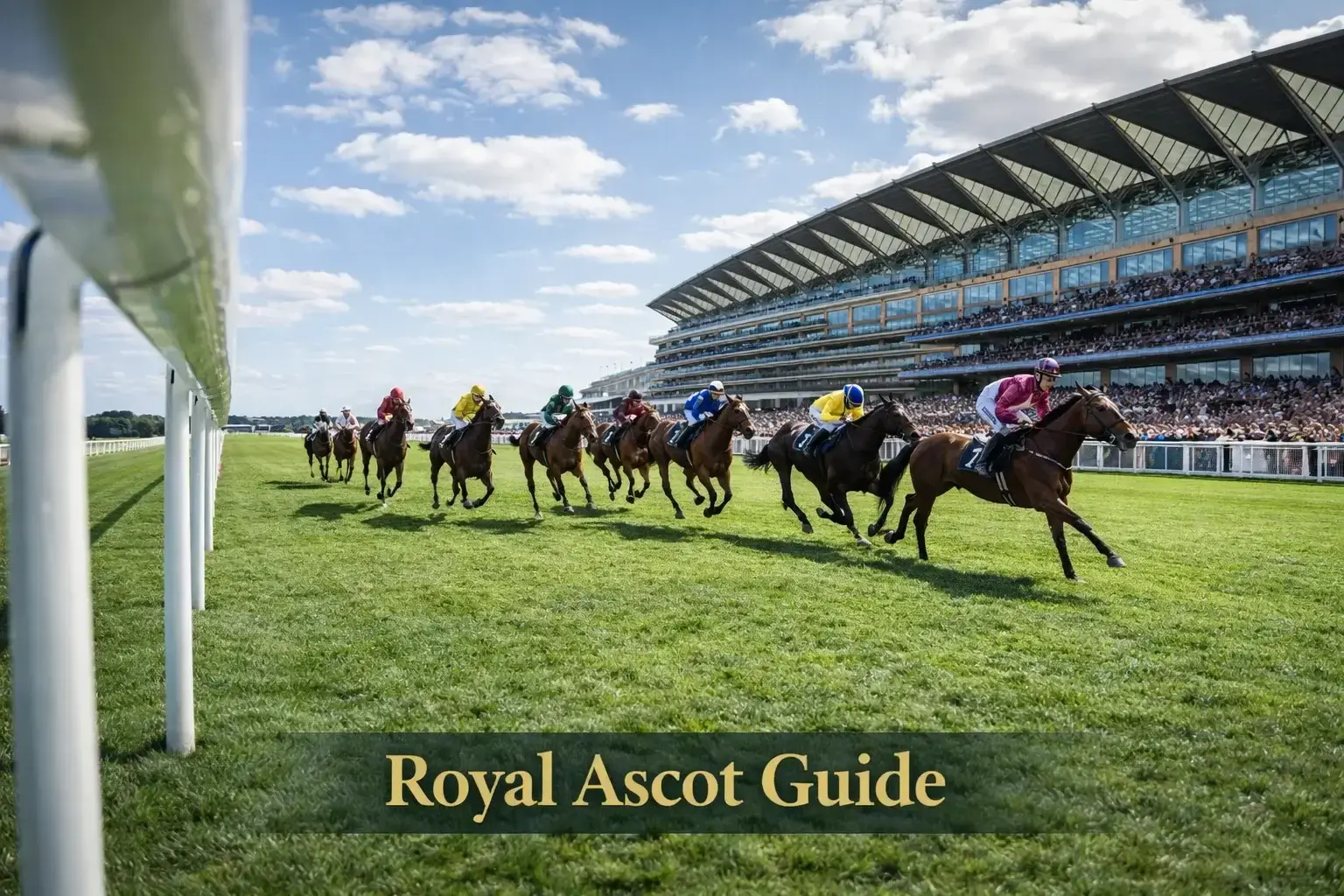
Where Sport Meets Pageantry — and Serious Money
Royal Ascot betting occupies a category of its own. Five days in June, thirty-five races, eight Group 1 contests, and a level of international competition that makes it the most prestigious Flat racing fixture anywhere in the world. The prize money is the deepest on the British Flat calendar, the fields are the most cosmopolitan, and the quality from the top of the card to the bottom is consistently higher than at any other domestic meeting.
The meeting also draws an audience that extends well beyond the core racing public. The Royal Procession, the dress code, and the social calendar make Ascot a national event in a way that few sporting fixtures can claim. Attendance at Royal Ascot rose 4.8 per cent in the first half of 2025, according to Racecourse Association data, and the meeting regularly draws crowds in excess of 70,000 on its busiest days. For bettors, that volume of interest means deeper markets, more liquidity, and greater competition for value.
Day-by-Day Feature Races
Tuesday opens with the Queen Anne Stakes, a Group 1 over a mile on the straight course that typically sets the tone for the week. The feature for many bettors on day one is the Coventry Stakes, a Group 2 for two-year-olds that has produced future Classic winners. The King Charles III Stakes (formerly the King’s Stand) is a five-furlong Group 1 sprint that attracts the fastest horses in training from Britain, Ireland, Australia, and beyond.
Wednesday’s card centres on the Prince of Wales’s Stakes, a Group 1 over a mile and two furlongs for older horses that often pits Classic winners against each other at weight-for-age. The Royal Hunt Cup, a mile handicap with a full field of thirty runners, is the betting race of the day — a cavalry charge down the straight course that rewards form students who can separate twenty-plus viable contenders.
Thursday is Gold Cup day. The Ascot Gold Cup over two and a half miles is the staying championship of the Flat — a test of stamina and class that has produced some of the most memorable performances in recent racing history. The Ribblesdale Stakes for three-year-old fillies and the Norfolk Stakes for juvenile sprinters provide Group-level support.
Friday features the Coronation Stakes, a Group 1 mile for three-year-old fillies that often serves as a rematch between Guineas runners from Newmarket, the Curragh, and Longchamp. The Commonwealth Cup, a Group 1 sprint for three-year-olds, is one of the newer additions to the programme and has quickly established itself as a highlight.
Saturday closes the meeting with the Diamond Jubilee Stakes, a six-furlong Group 1 that provides the definitive sprint championship. The Wokingham Stakes — a six-furlong handicap with a full field — is Saturday’s equivalent of the Royal Hunt Cup: a big-field cavalry charge with each-way value scattered across the betting market. The Hardwicke Stakes over a mile and a half and the Chesham Stakes for two-year-olds complete a card that rivals any Saturday fixture in world racing.
Form Factors Unique to Ascot
Ascot’s course configuration demands specific attention. The round course is right-handed and largely galloping, with a stiff uphill finish that tests stamina beyond the nominal distance. A mile race at Ascot is a more searching test than a mile race at most other British tracks because the final three furlongs climb steadily. Horses that finish strongly uphill have a demonstrable advantage over those that prefer flat finishes.
The straight course — used for races up to a mile — adds the draw as a variable. The stalls position can be significant, particularly in large-field handicaps where the field splits into groups on opposite sides of the track. Studying draw statistics at Ascot, by distance and going, is not optional if you’re betting in the Royal Hunt Cup or the Wokingham. A horse drawn on the wrong side of a twenty-runner sprint can be beaten before it reaches the two-furlong pole, regardless of its form.
International runners add a layer of uncertainty that domestic meetings rarely present. Horses trained in Ireland, France, Japan, Australia, and the United States are regular participants at Royal Ascot, and their form may be harder to evaluate than domestic rivals. Different racing styles, different rating systems, and different surface preferences make cross-border form comparison an imprecise exercise. Trainer record at the meeting — particularly for overseas yards that target Ascot year after year — is a more reliable guide than trying to compare a French Group 2 with a British Group 2 on raw numbers.
Betting Strategies for Ascot’s Big Fields
Royal Ascot’s handicaps and two-year-old races offer the widest betting opportunities. Average field sizes on Flat Premier racedays reached 10.86 in 2024, the highest post-pandemic figure, but Ascot’s handicaps regularly exceed that average by a wide margin. The Royal Hunt Cup and Wokingham routinely attract twenty-five to thirty runners, creating a pricing environment where the favourite’s win rate drops and longer-priced contenders have a realistic chance.
Each-way betting is the natural format for these big-field races. With bookmakers commonly offering four or five places at one-fifth the odds in fields of twenty or more, a horse at 16/1 or 20/1 that finishes in the frame delivers a meaningful return on the place portion alone. The key is identifying horses that have a strong each-way profile: consistent placers with proven form on good or good-to-firm ground, drawn on the right side, trained by a handler with a record at the meeting.
Ante-post markets for Royal Ascot open weeks in advance, particularly for the Group 1 races. The two-year-old races — Coventry, Norfolk, Chesham — attract speculative ante-post activity because the horses are lightly raced and the market is pricing largely on potential rather than proven form. This creates volatility and occasional value, but also significant non-runner risk, since juvenile form is unreliable and trainers frequently switch targets between trials and the meeting itself.
Ascot Beyond the Races: The Raceday Experience
Royal Ascot is a day out as much as a betting event, and for first-time visitors the experience itself is part of the appeal. The dress code — top hat and morning suit in the Royal Enclosure, smart attire elsewhere — sets Ascot apart from every other British racecourse. It contributes to an atmosphere that feels more like a state occasion than a sporting event, and for punters accustomed to the relaxed dress of a Saturday afternoon at Haydock, the contrast is striking.
The on-course betting environment is comprehensive. The bookmaker ring is larger than at most courses, the Tote operates multiple windows, and the Wi-Fi provision supports mobile betting from anywhere on the course. The parade ring — particularly before the Group 1 races — gives bettors a final opportunity to assess the runners in the flesh. At Ascot, where international raiders may be unfamiliar and going preferences uncertain, that physical assessment can tip the balance of a close decision.
Getting to Ascot is straightforward by train from London Waterloo (about an hour) with shuttle buses from the station, or by car with dedicated parking. Arrive early on busy days — the gates open several hours before the first race, and the best viewing spots and betting positions fill quickly. Royal Ascot is a fixture where the day rewards planning as much as the racing itself.