
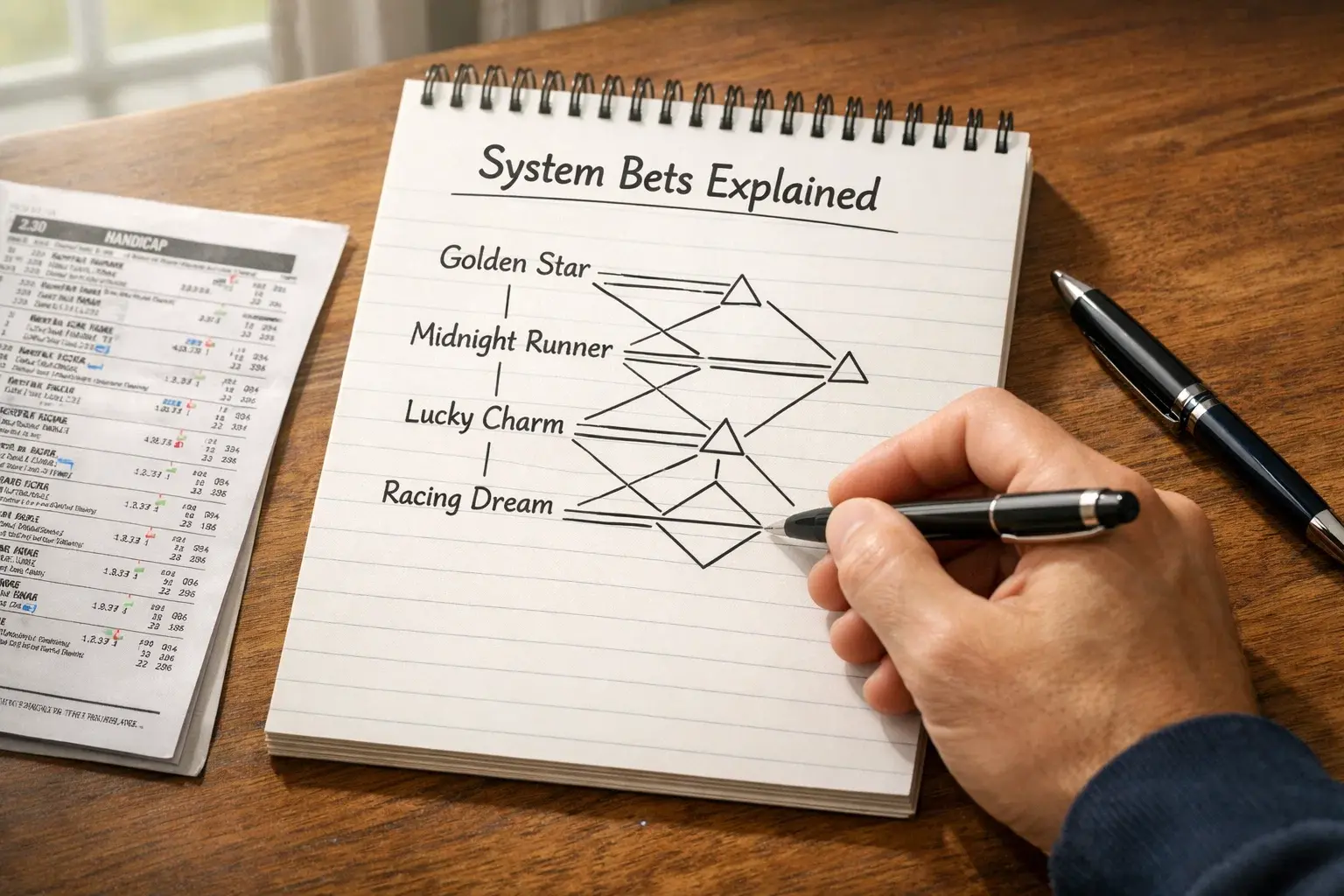
System Bets Insure Against the One That Got Away
System bets exist because accumulators are brutally unforgiving. Miss one leg out of five and the whole bet collapses. A Lucky 15, Yankee, or Heinz solves this problem by breaking your selections into every possible combination of singles, doubles, trebles, and higher multiples. If one or two selections fail, the surviving combinations can still produce a return. You pay more for this safety — the total stake is higher — but you don’t walk away empty-handed every time a single horse underperforms.
These bets have been a staple of Saturday afternoon punting in Britain for decades, and for good reason. In a sport where the racing industry contributes an estimated £4.1 billion annually to the UK economy, as stated in a House of Commons Library briefing citing BHA data, the volume of system bets placed across major meetings is substantial. They are particularly popular during festivals, where bettors have strong opinions across multiple races and want a structure that rewards partial success rather than demanding perfection.
Lucky 15: Fifteen Bets from Four Selections
A Lucky 15 is the most widely used system bet in horse racing. It takes four selections and covers every possible combination: four singles, six doubles, four trebles, and one four-fold accumulator. That’s fifteen individual bets, hence the name. If you stake £1 per line, your total outlay is £15.
The beauty of the Lucky 15 is its floor. Even if only one of your four horses wins, you collect on one single. Two winners give you two singles and a double. Three winners produce three singles, three doubles, and a treble. All four winners deliver the full set — four singles, six doubles, four trebles, and the four-fold — which is where the payout can become substantial.
Many bookmakers offer bonuses on Lucky 15 bets. A common enhancement is a consolation payout if only one horse wins — often double the odds on that single. Some also offer a percentage bonus if all four selections win, typically 10 to 20 per cent on top of the standard return. These bonuses make the Lucky 15 marginally better value than constructing the same fifteen bets individually, which is why it’s worth placing it as a named bet rather than entering each combination separately.
The practical application for racing is straightforward. Pick four horses you’re confident about across an afternoon card, place your Lucky 15, and you have a vested interest in every race without needing all four to win. Two winners at decent prices can return your stake and more. Three winners at medium odds can produce a very good afternoon. All four — rare, but not impossible — generates the kind of return that makes the Saturday feel worthwhile.
Yankee, Heinz, and Other Named Systems
A Yankee uses four selections like a Lucky 15 but drops the singles. It comprises six doubles, four trebles, and one four-fold — eleven bets in total. The lower stake is appealing, but the trade-off is significant: you need at least two selections to win before you see any return. One winner from four gives you nothing. For punters who are confident in the quality of their selections but want to keep the outlay below £15, the Yankee offers a middle ground.
A Trixie is the three-selection equivalent of a Yankee: three doubles and one treble, totalling four bets. Again, you need at least two winners. A Patent is the three-selection equivalent of a Lucky 15: three singles, three doubles, and one treble — seven bets, with a return possible from just one winner.
Moving up in complexity, a Heinz takes six selections and covers every combination: fifteen doubles, twenty trebles, fifteen four-folds, six five-folds, and one six-fold — fifty-seven bets in total. At £1 per line, that’s a £57 stake, which moves the Heinz out of casual territory and into the realm of committed punters who believe strongly in all six selections. The return profile is spectacular when it lands — six winners at decent prices can produce returns in the thousands — but the cost of entry means you’re investing more before a single horse leaves the stalls.
A Super Heinz (seven selections, 120 bets) and a Goliath (eight selections, 247 bets) exist for those who want even broader coverage, but these are rarely practical for horse racing. The cost escalation makes them prohibitive at anything other than tiny unit stakes, and the number of selections required makes it near-impossible to maintain quality across every leg.
Calculating Your Total Stake and Potential Returns
The total cost of any system bet is the unit stake multiplied by the number of individual bets. A £2 Lucky 15 costs £30. A £1 Heinz costs £57. Before placing the bet, know the total outlay — it’s easy to underestimate how quickly the cost adds up, particularly with the larger systems.
Calculating potential returns is harder because it depends on which horses win and at what prices. The simplest approach is to use an online bet calculator, available on most bookmaker sites and numerous independent tools. Enter your selections, their odds, and the system type, and the calculator shows your return for every possible combination of winners.
As a rough benchmark: a Lucky 15 where two of four selections win at average odds of 4/1 each returns approximately £35 to £40 on a £1-per-line stake — a profit against the £15 outlay. Three winners at 4/1 returns roughly £150 to £170. All four at 4/1 generates around £600. These figures shift dramatically with the odds involved. Replace one 4/1 winner with a 10/1 shot and the returns climb sharply, because the winning doubles, trebles, and four-fold all benefit from the longer price.
Favourites win 30 to 35 per cent of UK races, and backing them blindly produces a return on investment of around 93 per cent — a loss of 7p per pound staked. In system bets, this margin compounds less aggressively than in accumulators because the singles and lower-order combinations anchor the return profile. A system bet built around selections at fair odds is structurally more resilient than an accumulator, even if the maximum upside is lower.
When System Bets Make Sense for Racing
System bets work best on days with multiple competitive races where you have genuine form-based opinions on several contests. Saturday afternoon cards at major meetings, festival days, and big televised fixtures provide the natural environment. These are the days when you’re likely to have three or four strong views — not every day, and not at every meeting.
They make less sense on quiet midweek cards where the races are weaker and the form is muddier. Placing a Lucky 15 across four low-grade handicaps at a Monday all-weather meeting is just an expensive way to discover that you can’t reliably pick winners in races where the form gives nobody a clear edge.
The financial discipline is important. Your system bet stake should sit within your entertainment budget, not your serious betting allocation. The singles and lower combinations within a system bet provide genuine insurance against total loss, but the bet as a whole carries a negative expected value — just less negative than an equivalent accumulator. Use them when the card warrants it, size them within what you can afford to lose, and treat a good return as a bonus rather than an expectation.