
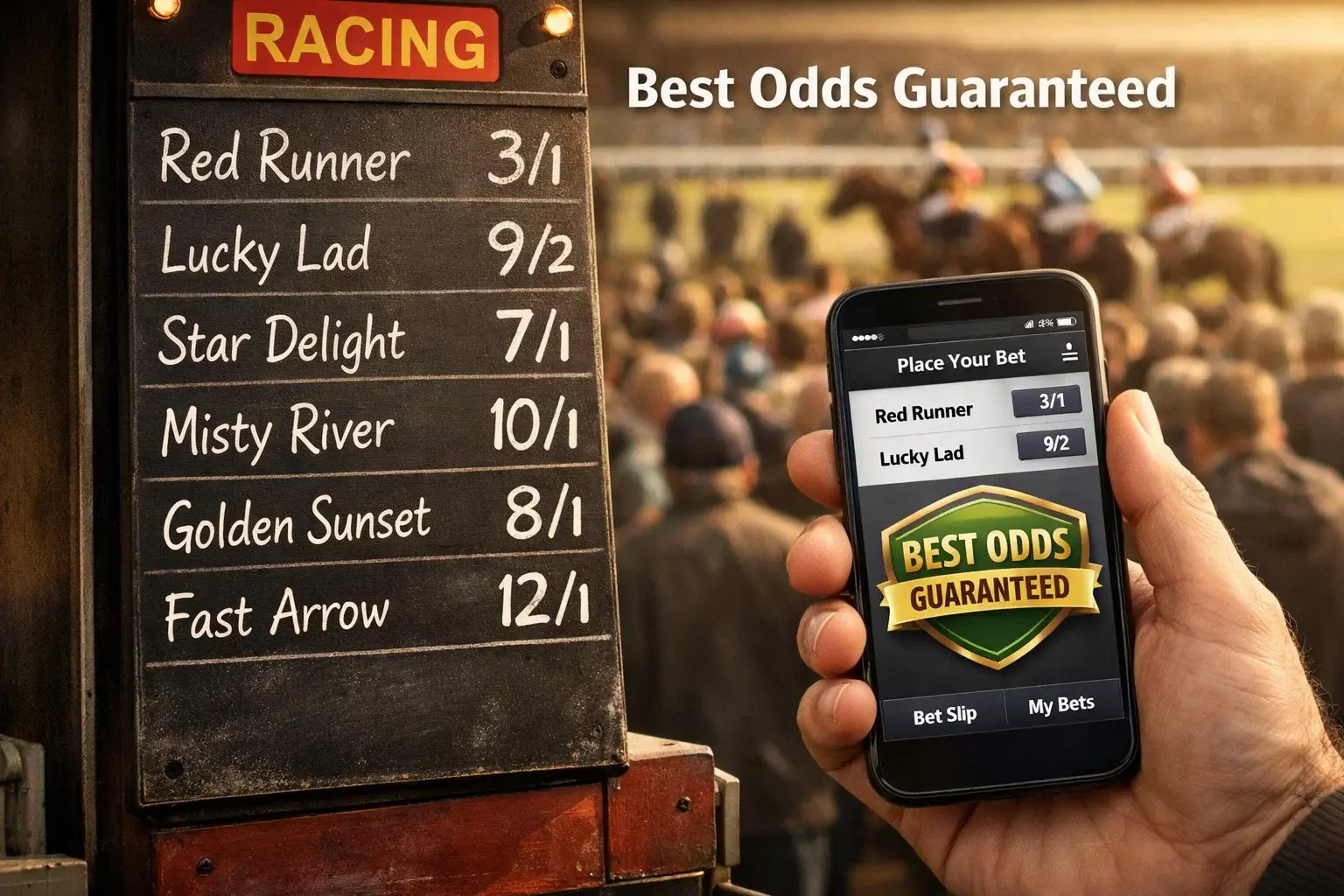
BOG Means You Never Lose Out to a Price Drift
Best Odds Guaranteed is one of the few promotions in horse racing betting that consistently works in the punter’s favour. The premise is simple: you take an early price on a horse, and if the Starting Price turns out to be higher, the bookmaker pays you at the bigger price instead. You lock in your selection when you want to, and the market can only move in your direction.
In a sport where odds can shift significantly between the morning and the off — driven by stable money, market intelligence, and late withdrawals — BOG removes the anxiety of backing a horse early and watching the price drift out. It also eliminates the opposite regret: seeing a horse you backed at 5/1 go off at 8/1 and knowing you left value on the table. With BOG, you would have been paid at 8/1 regardless.
The scale of UK horse racing betting makes this feature commercially significant. Remote betting on horse racing generated £766.7 million in gross gambling yield in the financial year ending March 2025, according to the Gambling Commission’s annual industry statistics. In a market of that size, even marginal price improvements across millions of bets add up to a meaningful transfer of value from bookmaker to customer.
How BOG Triggers on Race Day
The mechanics are automatic at most major bookmakers. You place a bet on a UK or Irish horse race at the advertised fixed odds — say, 6/1 in the morning. The race goes off and the official Starting Price is returned at 9/1. Under BOG terms, your bet is settled at 9/1, the higher of the two prices, without you needing to do anything. The adjustment happens in the settlement process.
If the Starting Price is lower than or equal to the price you took, nothing changes. You simply get paid at your original price. BOG only activates when the SP exceeds your fixed odds. It’s a one-way ratchet — prices can go up for you, but never down.
Most bookmakers apply BOG to win bets and the win part of each-way bets. The place portion of an each-way bet is typically settled at your original fixed odds, not at the SP. This is a detail worth knowing, because it means BOG has its greatest impact on outright win bets and the win component of each-way wagers. Some operators extend BOG to the place part as well, but it’s not universal — always check.
Timing matters. BOG usually applies to bets placed on the day of the race, from the morning prices onwards. Ante-post bets placed days or weeks in advance are not covered. The bookmaker is offering BOG as a day-of-race incentive to encourage early betting, not as an open-ended price guarantee stretching back to when the market first opened.
Which Bookmakers Offer BOG and Any Restrictions
Most major UKGC-licensed bookmakers offer Best Odds Guaranteed on UK and Irish horse racing as a standard feature. It’s one of the most common ongoing promotions in the sector, and its absence from a bookmaker’s offering is more notable than its presence. The competitive pressure in a market where online betting GGY grew 12 per cent year-on-year in the first quarter of 2024–25 means that dropping BOG would risk losing customers to rivals who maintain it.
That said, restrictions apply, and they vary. Some bookmakers cap the maximum payout uplift from BOG — if your original odds were 10/1 and the SP is 25/1, the bookmaker might limit the BOG benefit to a maximum price of, say, 20/1. Others restrict BOG to bets placed online or via their app, excluding telephone and on-course bets. A few operators exclude certain race types, such as all-weather fixtures or races at smaller meetings.
There are also stake-based limitations. High-staking customers may find that BOG doesn’t apply above a certain stake level, or that their accounts have been excluded from the promotion following a pattern of profitable betting. This is less a formal restriction and more a practical reality of how bookmakers manage liability — if you consistently take early prices that drift, the bookmaker is paying above SP on every qualifying bet, and that margin has to come from somewhere.
The key advice is to read the specific terms on the bookmaker you use. BOG is marketed as a headline feature, but the conditions underneath vary enough that two punters with accounts at different bookmakers can get materially different treatment on the same bet.
BOG vs Taking the SP — A Practical Comparison
Without BOG, a punter faces a genuine dilemma on race morning. Take the early price and risk the horse drifting — meaning the SP might have been better. Or leave it and take the SP, risking the opposite: the horse shortens as money comes for it, and the SP is shorter than the morning price was.
BOG resolves the first half of this problem. You take the early price and, if the SP turns out higher, you get the SP. The only scenario where you miss out is when the horse shortens — but in that case, your early price was already the better deal, so you haven’t lost anything. You’ve just failed to benefit from a market move that went in your favour.
Consider a practical example. A horse is 7/1 at 10am. By the off, it’s been backed down to 9/2. Without BOG, the punter who took 7/1 in the morning has a significantly better price than the SP backer. With BOG, the morning punter still gets 7/1, which is the higher price. Now reverse the scenario: the horse drifts to 12/1 by the off. Without BOG, the morning punter is stuck at 7/1. With BOG, they’re paid at 12/1. The asymmetry always favours the BOG holder.
Taking the SP deliberately — betting at the last moment to get whatever price the on-course market produces — has one remaining advantage: it reflects the most up-to-date information. Late non-runners, market support, and jockey bookings announced close to the off can all affect the SP in ways that morning prices don’t capture. But for most recreational bettors, the convenience and protection of an early-morning selection with BOG outweighs the informational edge of waiting for the SP.
Is BOG Worth Switching Bookmakers For?
On its own, probably not. BOG is widely available, and the price improvements it delivers on any single bet are typically modest — the SP exceeds the early price by a point or two in most races, not by a transformative margin. Over hundreds of bets across a season, though, the cumulative effect is real. A punter who consistently takes early prices with BOG active will, on average, achieve a higher effective price than one who bets at SP or uses a bookmaker without the offer.
Where BOG becomes a genuine differentiator is in combination with other features. A bookmaker that offers BOG alongside competitive early prices, a good range of racing markets, live streaming, and reliable in-play options is a stronger overall package than one that leads on BOG alone. The promotion is a hygiene factor — its absence is a red flag, but its presence doesn’t by itself indicate a superior service.
The more useful question is whether your current bookmaker’s BOG terms are genuinely unrestricted. If you’re capped, excluded from certain meetings, or finding that BOG doesn’t apply to stakes above a modest threshold, then moving to an operator with cleaner terms will have a measurable effect on your returns over time. In a market this large and this competitive, there’s no reason to accept a restricted version of a feature that most operators offer fully.