
 Available in US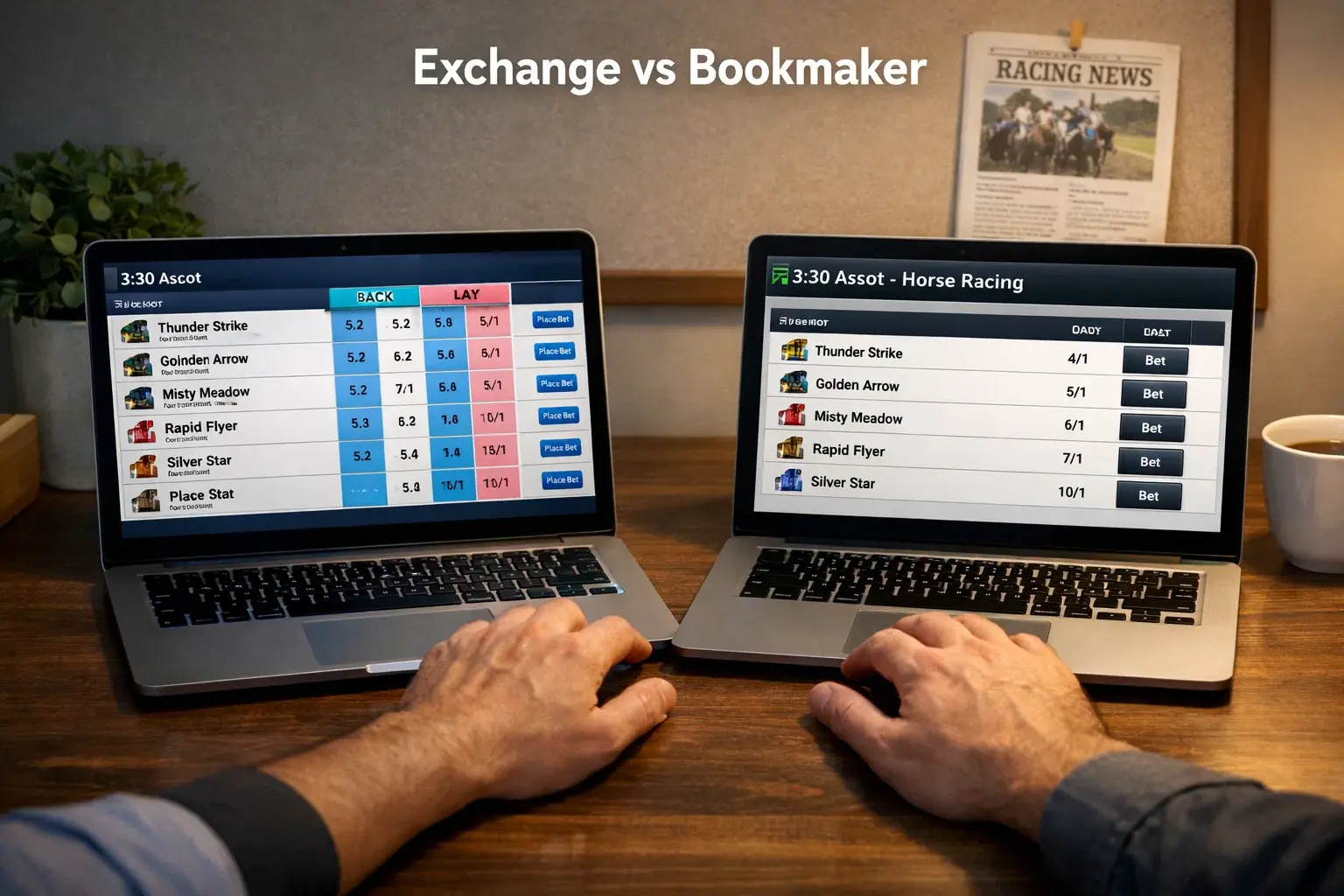
Two Fundamentally Different Betting Models
A horse racing betting exchange and a traditional bookmaker both let you bet on the same races, but the underlying mechanics are so different that they produce different odds, different opportunities, and different risks. With a bookmaker, you bet against the house. The bookmaker sets the price, takes your stake, and pays out from their own funds if you win. With an exchange, you bet against other punters. The exchange provides the platform, matches your bet with someone willing to take the opposite side, and takes a small commission on winning bets.
This structural difference has practical consequences for every bet you place. Exchange odds are typically closer to the true probability of an outcome because there’s no bookmaker margin built in — just a commission that’s usually lower than the overround. But exchanges carry their own limitations: liquidity varies, not every market is deep enough to get matched at the price you want, and the user experience is less straightforward than clicking a button on a bookmaker’s app.
Martin Cruddace, CEO of Arena Racing Company, has drawn a sharp line between the different corners of the gambling market, noting that “unlike online casino games, British horseracing makes an enormous contribution to society and employment, has vastly different rates of gambling-related harm and is not available every 10 seconds, 24 hours a day.” That distinction matters for exchange users too: exchanges have created substantial horse racing markets, but the ability to lay a horse to lose has generated ongoing integrity discussions that don’t apply to traditional bookmaker bets.
How an Exchange Works — Backing and Laying
On an exchange, every bet has two sides: a backer and a layer. The backer wants the horse to win (or place), just like a standard bet. The layer is effectively acting as the bookmaker — they’re betting that the horse will not win, and they stand to lose if it does.
When you back a horse at 5.0 (4/1 in fractional odds) on an exchange, someone else has offered to lay that horse at that price. If the horse wins, the layer pays you the winnings and the exchange takes a commission on your profit. If the horse loses, you lose your stake to the layer, and the exchange takes commission from the layer’s profit. The exchange itself has no financial interest in the outcome — it earns money from commission regardless of which side wins.
Laying is the feature that separates exchanges from everything else. It allows you to profit from a horse losing, which opens up entirely new strategies. If you believe the market has overrated a horse — perhaps a well-known name with declining form — you can lay it rather than trying to identify which of the other runners will beat it. The risk, however, is that your liability on a lay bet can be substantial. Laying a horse at 10.0 for a £10 stake means you’re liable for £90 if it wins. Lay betting demands strict discipline around liability management.
Commission Structures and Effective Odds
Exchanges charge commission on net winnings, typically between 2 per cent and 5 per cent depending on the platform and any loyalty discounts applied to your account. The standard rate on Betfair, the largest exchange, starts at 5 per cent for new customers and can reduce to 2 per cent or lower for high-volume users.
This commission erodes the price advantage that exchanges would otherwise have over bookmakers. If a horse is available at 6.0 on the exchange and 5.5 with a bookmaker, the exchange looks better — but after 5 per cent commission on a winning bet, your effective odds on the exchange are 5.75. Still better than the bookmaker in this case, but the gap has narrowed. On closer price differentials, the commission can eat the advantage entirely.
One area where the commission structure creates a clear edge is on shorter-priced selections. Bookmakers build their margin into every price, and that margin is proportionally larger on favourites because those bets are placed most frequently. On an exchange, the back price on a favourite is typically closer to its true probability because there’s no overround — just the commission on profit. For punters who regularly back favourites, the cumulative saving from exchange prices can be meaningful over a season.
Research across multi-year datasets suggests that systematically backing favourites at bookmaker SP produces an average ROI of around 93 per cent — a loss of roughly 7p in every pound. Exchange prices, after commission, tend to reduce that loss, though they don’t eliminate it entirely. The margin improvement is real but modest, and it only matters over a large volume of bets.
When Exchange Prices Beat the Bookmaker
The exchange price advantage is most visible in three scenarios. First, on well-backed favourites where bookmaker margins are widest. The exchange back price is often a full point or more above the bookmaker’s fixed odds in these situations, because the exchange price reflects genuine peer-to-peer supply and demand rather than a bookmaker’s risk-managed position.
Second, in the final minutes before a race. Exchange markets are most liquid close to the off, when the majority of trading volume occurs. This is when the exchange price most closely reflects the true market — and when the discrepancy with bookmaker SP is often largest. If you’re comfortable monitoring the market in the minutes before a race, the exchange frequently offers superior value at that point.
Third, on lay betting opportunities. There is no bookmaker equivalent of a lay bet. If your analysis suggests a horse is overpriced by the market — too short given its form and conditions — laying it on the exchange is the only direct way to profit from that opinion. This is particularly useful at major festivals where hype and public sentiment can push popular names to prices shorter than their ability justifies.
The Gambling Commission’s market data shows that gross gambling yield from licensed betting operators on the high street fell 3 per cent year-on-year in the final quarter of the 2024–25 financial year. The migration from shop-based to digital betting continues, and within the digital space, exchanges represent a distinct segment that rewards engaged, analytical bettors who are willing to trade the simplicity of a bookmaker for a pricing edge.
Risks and Limitations of Exchange Betting
Liquidity is the primary practical limitation. Major UK and Irish racing attracts deep exchange markets — there’s almost always money available on the favourite at Cheltenham or Royal Ascot. But a Tuesday afternoon handicap at Catterick might have thin backing and laying activity, making it difficult to get matched at the price you want or at a meaningful stake. If your betting focuses on smaller meetings or less popular races, exchanges may not reliably serve your needs.
The user experience is more complex. Exchange interfaces display back and lay prices, the amount of money available at each price, and sometimes in-play trading graphs. For someone used to a bookmaker’s clean list of odds and a one-click bet slip, the exchange can feel overwhelming. The learning curve is not steep, but it exists, and mistakes — particularly around lay liability — can be expensive.
There’s also the question of account restrictions. Bookmakers routinely restrict profitable customers by limiting stakes or closing accounts. Exchanges generally don’t do this, because they earn commission regardless of whether you win or lose. For consistently profitable bettors, this is the single biggest structural advantage of exchange betting: you can continue to bet at full capacity without worrying about your account being throttled. That freedom, combined with typically better odds, is why many serious racing punters treat the exchange as their primary platform and use bookmakers only for specific promotions like BOG or enhanced place terms.
Betting Exchanges vs Bookmakers — More on this topic at betting on horse racing.
See also Articles.
