
 Available in US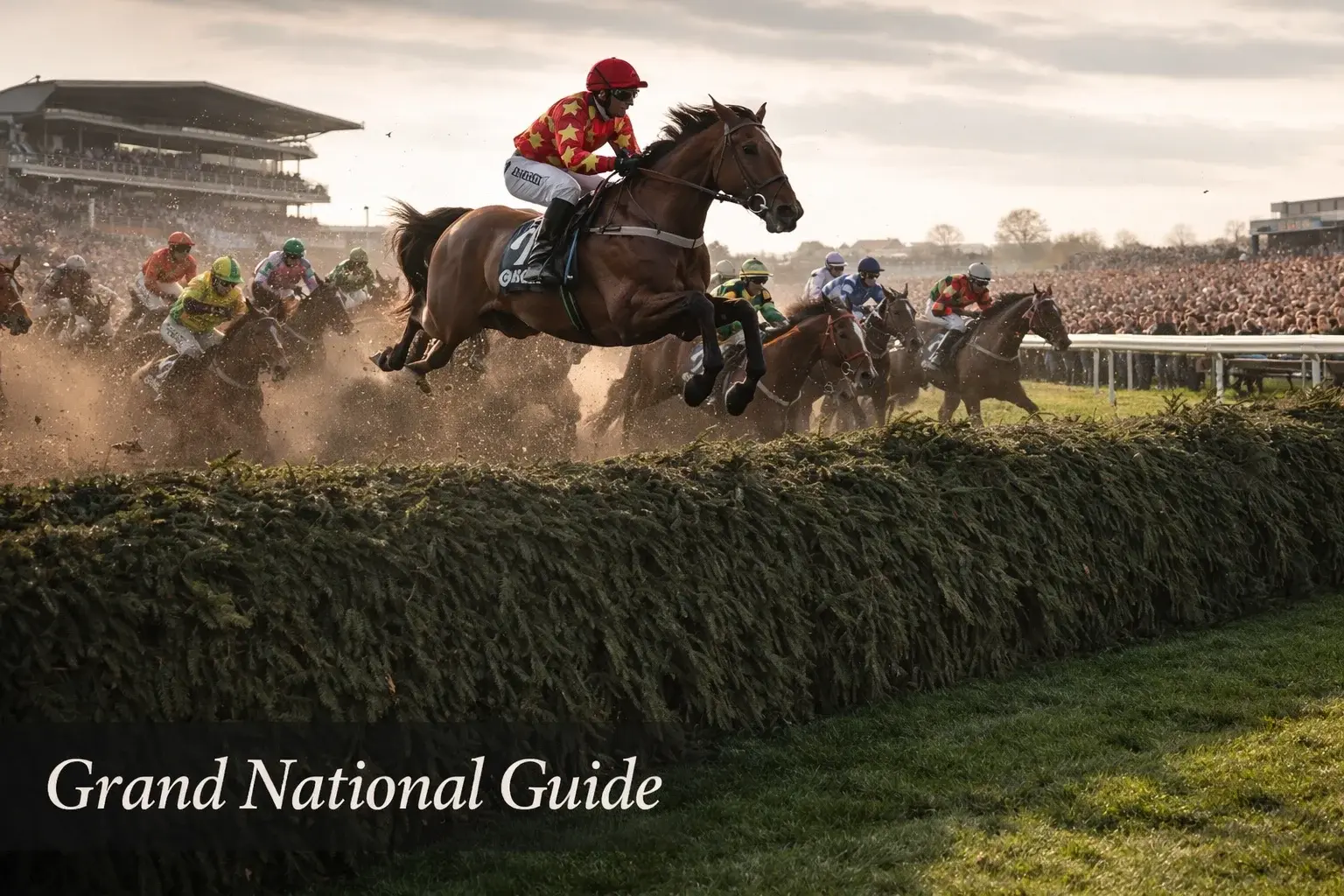
The One Race Where the Whole Country Bets
Grand National betting is unlike anything else in the racing calendar. It is the single most bet-on horse race in Britain — the one event that draws in millions of people who wouldn’t normally look at a racecard from one year to the next. Office sweepstakes, family pools, casual punters having a flutter on a name they like: the Grand National is horse racing’s annual open invitation to the general public, and the bookmakers price their markets accordingly.
The race itself has run at Aintree since 1839, and the scale of the event — up to thirty-four runners since the field was reduced from forty in 2024, thirty fences, four miles and two and a half furlongs — makes it one of the most demanding and unpredictable contests in sport. Over five million people attended British racecourses in 2025, and the Aintree Grand National Festival was a significant contributor, with the Racecourse Association reporting a 4.1 per cent attendance increase for the meeting. But the on-course crowd is a fraction of the audience — the race is broadcast live on ITV to a peak television viewership of several million more.
Course, Fences, and What Makes It Unique
The Grand National course at Aintree is not used for everyday racing. It is a purpose-built layout featuring fences that are larger, stiffer, and more demanding than those at any other British racecourse. Becher’s Brook, The Chair, and the Canal Turn are the most famous obstacles — each with characteristics that test jumping accuracy, courage, and composure under pressure.
The race covers two circuits of the course. Horses jump sixteen fences on the first circuit and fourteen on the second (The Chair and the Water Jump are omitted on the second lap). The distance — just over four miles and two furlongs — is the longest of any race in the mainstream British calendar. Stamina is not optional; it is the baseline requirement. Horses that run out of energy in the final half-mile are not just beaten, they often fail to complete the course.
Modifications to the fences over the past decade have improved safety without fundamentally changing the character of the race. The cores of the fences are now built to a specification that allows them to give slightly on impact, reducing the severity of falls. The approach to Becher’s Brook has been levelled to eliminate the steep drop on the landing side that historically caught out less experienced jumpers. These changes have reduced the fatality rate while preserving the Grand National’s status as the ultimate test of horse and rider over fences.
Grand National Odds Patterns and Historical Data
The Grand National’s defining characteristic from a betting perspective is its unpredictability. This is a handicap steeplechase with the largest field in British racing, run over a course and distance that most horses encounter only once a year. The favourite’s record reflects this: Grand National favourites have a win rate significantly below the 30–35 per cent average seen across UK racing as a whole. In many years the favourite goes off at double-figure odds, a reflection of how wide-open the betting market considers the race.
Winners have come from across the price spectrum. Recent decades have produced winners at odds as short as 5/1 and as long as 100/1. The median winning SP tends to sit in the 10/1 to 25/1 range — prices that offer substantial each-way value in a race where bookmakers commonly pay five or six places. The distribution of winning prices is flatter than in any other major race, which is why form analysts and pin-stickers coexist at the Grand National more comfortably than anywhere else.
Alan Delmonte, Chief Executive of the Horserace Betting Levy Board, has noted that “this is not the first time in recent years that Cheltenham has had a significant impact on yield, a reflection of the essential unpredictability of the sport.” That unpredictability applies in concentrated form to the Grand National, where the relationship between pre-race assessment and actual outcome is looser than at any other fixture. The race’s results can move the annual levy yield measurably in one direction or another — bookmaker-friendly or punter-friendly — depending on whether favourites run to form or outsiders prevail.
Key Factors: Weight, Age, Course Experience
In a race where the margin between finishing and failing to complete is finer than anywhere else, the selection criteria need to be functional rather than aspirational. Three factors consistently correlate with Grand National performance.
Weight is the most quantifiable. The Grand National is a handicap, and the weight range from top to bottom can stretch two stone or more. Horses near the top of the weights carry 11 stone 10 pounds or more; those at the bottom might carry 10 stone. Historical data shows that winners have come from across the weight range, but the clustering is towards the middle — horses carrying between 10 stone 7 pounds and 11 stone 2 pounds have produced the majority of recent winners. The very top weights face the dual burden of carrying more and being targeted by the market; the very bottom weights are there because the handicapper rates them as the weakest.
Age matters in a race of this severity. Horses aged eight to ten have the strongest record. Younger horses may lack the experience and physical maturity to cope with the unique demands of Aintree’s fences. Older horses may lack the freshness to sustain their effort over four miles of heavy ground. The age range is not a rigid rule, but it narrows the field meaningfully.
Previous course experience is a genuine advantage. Horses that have run at Aintree before — whether in the Grand National itself, the Topham Trophy over the same fences, or the Becher Chase in December — have encountered the unique obstacles and know what to expect. First-time Grand National runners face an additional layer of unpredictability: however talented they are over conventional fences, Aintree’s obstacles are different enough to unsettle even accomplished jumpers.
Place Betting and Each-Way Strategy for Large Fields
The Grand National is the each-way bettor’s premier event. With up to thirty-four runners and most bookmakers paying five or six places (some offering seven), the place portion of an each-way bet covers a wide finishing range. A horse at 25/1 each-way with six places at one-fifth the odds gives you 5/1 on the place portion — a price that pays for a finish in the top six of a large-field race.
The strategy that experienced National bettors follow is to identify horses with a strong chance of completing the course and finishing in the frame, even if they’re not necessarily expected to win. Completion rate is the first filter: how many of the thirty-odd starters actually finish? The answer varies by year, but typically between twenty and thirty horses complete. Of those, six or seven are paid places. Your each-way selection needs to be among that finishing group and competitive enough to be in the leading pack at the end of four miles.
Multiple each-way selections can be sensible in this race specifically. Placing two or three each-way bets on horses at 20/1 or longer, with the understanding that one or two will fail to complete while the third might place, is a structured approach that acknowledges the race’s inherent chaos rather than pretending it can be solved by form alone. The total outlay is higher, but the expected value of each-way coverage in a large-field handicap with extended place terms is more favourable than in almost any other race on the calendar.
Grand National Betting Guide — More on this topic at betting on horse racing.
See also Royal Ascot Betting Guide.
