
 Available in US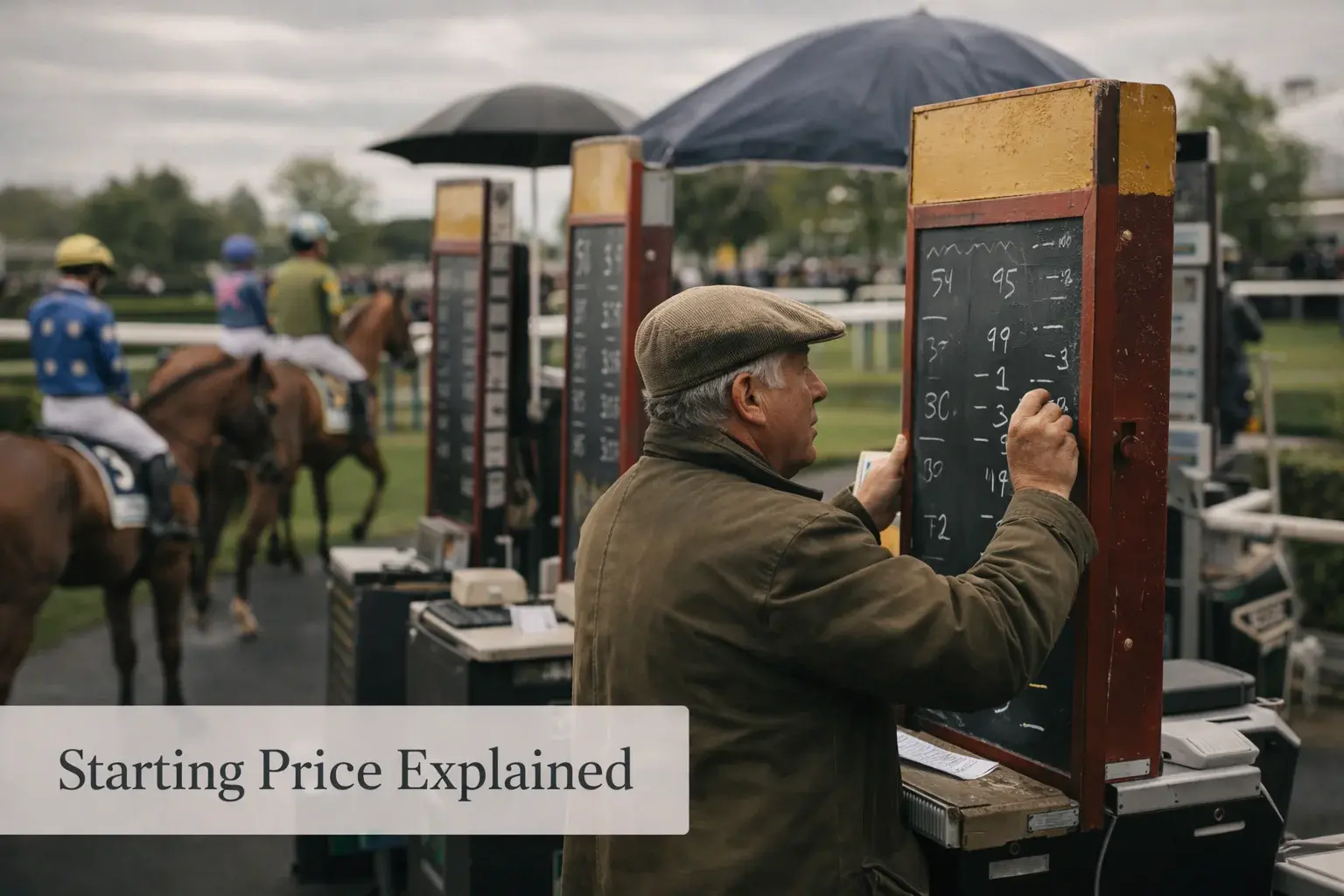
SP Is the Final Word on Your Horse’s Price
The Starting Price is the official odds at which a horse begins a race, and it serves as the settlement benchmark for a significant portion of UK horse racing bets. If you didn’t take a fixed price earlier in the day, or if your bookmaker settles at SP by default, this is the number that determines your return. Understanding what the SP means in horse racing — how it’s formed, what it reflects, and when it’s the right choice — removes one of the most common sources of confusion for new bettors and provides experienced punters with an additional decision-making tool.
The SP also underpins several protective mechanisms in the sport’s betting framework, most notably the Non-Runner No Bet rule. Together, SP and NRNB form the backbone of how late market changes — withdrawals, drifts, gambles — are handled by bookmakers and bettors alike.
How the Starting Price Is Determined
The Starting Price is not set by a single bookmaker or a computer algorithm. It’s compiled from the on-course betting ring — the physical row of bookmakers at the racecourse — by an independent Starting Price reporter employed by the Racing Post and working under rules agreed with the sport’s regulatory bodies.
The reporter surveys the prices displayed by on-course bookmakers immediately before the race starts. From that snapshot, they calculate a representative price that reflects the balance of supply and demand in the ring at the off. If the majority of on-course bookmakers are showing 5/1 on a horse, the SP will be 5/1. If prices are spread — some showing 5/1, others 9/2 — the reporter assesses the weight of money and sets the SP accordingly.
This process means the SP reflects genuine market activity at the racecourse, not the opinions of remote bookmakers or the pre-race trading on betting exchanges. It’s an on-course product, derived from the same bookmaker ring that has operated at British racetracks for over two hundred years. The volume of money flowing through that ring has been declining — total betting turnover on British racing fell 4.2 per cent in the first nine months of 2025 compared with the same period in 2024, according to BHA Racing Report data — but the SP compilation mechanism remains unchanged.
The SP is returned for every runner in every race, regardless of whether the horse won, placed, or trailed home last. It’s published immediately after the off and becomes the definitive price for settlement purposes. Bookmakers use it to pay out bets placed at SP, and it serves as the reference price for features like Best Odds Guaranteed, where the bettor receives the higher of their fixed price or the SP.
SP vs Early Price — When to Take Which
The choice between taking an early fixed price and leaving your bet at SP is one of the most common tactical decisions in horse racing. Neither is universally superior — the right approach depends on the horse, the race, and your reading of how the market is likely to move.
Take the early price when you believe the horse will shorten. If the morning price is 8/1 and you expect a wave of support to push it into 5/1 by the off, locking in 8/1 secures you the better price. This is the scenario where Best Odds Guaranteed has no downside — if the SP turns out higher than 8/1, your bookmaker pays the SP instead. If it’s lower, you keep your 8/1.
Leave it at SP when you expect the horse to drift, or when you want the most up-to-date market information reflected in your price. A horse showing 4/1 in the morning might drift to 6/1 by the off if stable confidence is lukewarm or if a rival attracts strong late support. Taking the SP in that scenario gives you the longer price without needing to monitor the market throughout the day.
There’s also a practical case for SP when you’re betting on course. In the ring, the prices are changing constantly, and the SP captures the final moment of those changes. If you’re at the track and can’t easily compare prices across multiple bookmakers, betting at SP means you get whatever the independent reporter compiles — a neutral, consensus price free from the quirks of any individual bookmaker’s book.
Odds-on favourites on the Flat win between 55 and 60 per cent of the time, and their SPs are typically tight — the market knows what it thinks about short-priced horses, and late movement is often minimal. At longer prices, SP volatility increases, which is where the early-price-versus-SP decision carries more weight. A horse at 14/1 in the morning could easily be 10/1 or 20/1 by the off. The direction of that movement determines which approach would have served you better.
Non-Runner No Bet: How the Rule Protects You
Non-Runner No Bet is a betting condition under which your stake is refunded if your selected horse doesn’t run. It applies automatically to most bets placed on the day of a race once the market moves from ante-post to day-of-race pricing — typically from the morning of the race or once final declarations have been made.
The protection is straightforward: if a horse is withdrawn before the off, your bet is voided and your stake returned. This covers scratching for any reason — injury, going concerns, a trainer’s late decision, a veterinary issue at the course. You bear no risk from the horse’s non-participation.
NRNB does not apply to ante-post bets unless specifically stated. The distinction matters because ante-post markets often remain open alongside day-of-race NRNB markets. A horse might be 10/1 ante-post (no refund if it doesn’t run) and 7/1 NRNB (refund guaranteed). The price difference is the cost of the insurance, and both markets can be available simultaneously through the same bookmaker.
For bettors who place their bets on the morning of the race — the majority of online horse racing activity — NRNB is effectively the default. You’re protected from late withdrawals without needing to opt into anything. The concern only arises if you place bets days or weeks in advance, where the ante-post rules take over and the non-runner risk lands on you.
Rule 4 Deductions When a Horse Withdraws Late
When a horse is withdrawn from a race after the final declarations but before the off — or in rare cases, at the start — a Rule 4 deduction may apply to winning bets. This is because the withdrawal of a runner changes the competitive landscape: a field of ten is now a field of nine, and the remaining horses’ chances have all improved marginally. The Rule 4 deduction adjusts payouts to reflect that changed probability.
The deduction scale is based on the withdrawn horse’s SP at the time of withdrawal. If the withdrawn horse was a short-priced favourite, the deduction is larger because its absence has a bigger impact on the market. A horse withdrawn at SP of 1/1 (evens) triggers a deduction of 45p in the pound from winning returns. A horse withdrawn at 10/1 triggers a deduction of just 5p in the pound. If the withdrawn horse was a rank outsider, the deduction may be zero.
Rule 4 deductions are applied by the bookmaker automatically and are not negotiable. They can feel punitive — particularly when you backed the winner at a price that anticipated the full field, only to have your return reduced because an unrelated horse didn’t make the start. But the logic is sound: the odds you were offered reflected a market that included the now-absent runner, and the deduction corrects for that.
The deduction applies to bets placed at fixed odds before the withdrawal was known. Bets placed after the withdrawal — when the remaining runners have been repriced — are not subject to Rule 4, because the new prices already account for the missing horse. If you’re betting close to the off and a horse has just been withdrawn, check whether the market has been repriced before you stake. If it has, you’re getting the adjusted price with no deduction risk.
Starting Price and Non-Runner No Bet Rules in Horse Racing — More on this topic at betting on horse racing.
See also Handicap Races Explained.
