
 Available in US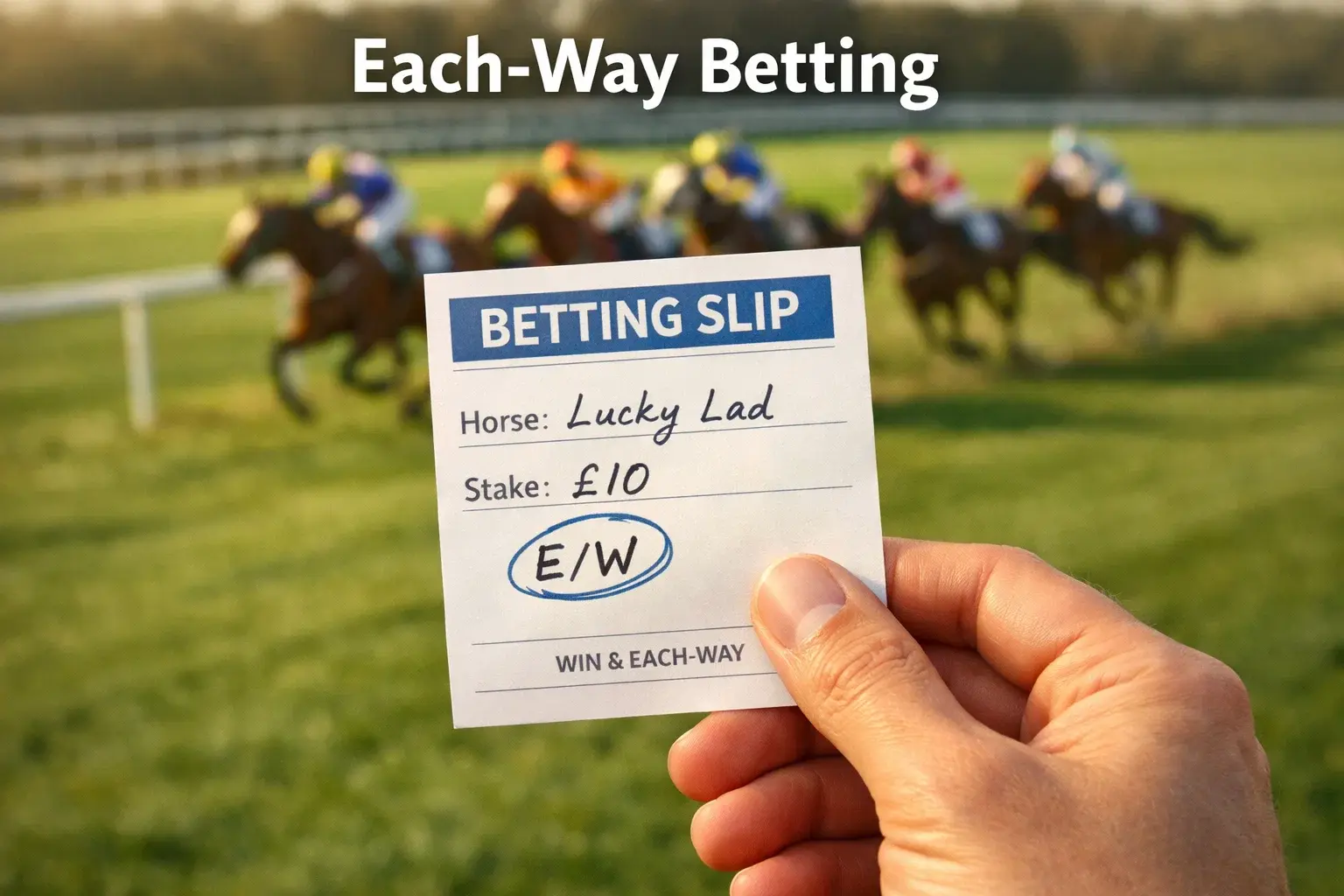
Two Bets in One — Why Each-Way Exists
Each-way betting is the closest thing horse racing offers to a safety net. Rather than staking everything on your horse crossing the finish line first, an each-way bet splits your wager into two separate parts: one on the horse to win and one on it to place. If the horse wins, both parts pay out. If it finishes in a place position but not first, you lose the win portion but collect on the place portion. If it finishes outside the places, you lose both.
The concept exists because horse racing is fundamentally volatile. Across British racing, favourites win roughly 30 to 35 per cent of races, according to multi-year analysis covering thousands of results from 2002 to 2021. That means even the horse the market considers most likely to win loses about two-thirds of the time. Each-way betting addresses this reality by giving you a second chance at a return when your selection runs well but doesn’t quite get there.
Understanding what is each way betting matters because it changes your approach to selection. You stop thinking solely about winners and start evaluating which horses are likely to be competitive. That shift opens up an entirely different set of opportunities — particularly in large-field handicaps where the favourite’s win rate drops further and place finishes become more achievable.
How the Win and Place Parts Work
When you place an each-way bet, your total stake is doubled. A £10 each-way bet costs £20 — £10 on the win and £10 on the place. These are treated as two independent bets by the bookmaker, though they’re linked to the same horse.
The win part is straightforward: it pays at the full advertised odds if your horse finishes first. If you back a horse at 8/1 with a £10 win stake and it wins, you receive £80 profit plus your £10 stake returned — £90 total from the win portion alone.
The place part pays at a fraction of the full odds, known as the place terms. These fractions are set by the bookmaker and depend on the type of race and the number of runners. The most common place terms in UK racing are one-quarter of the odds and one-fifth of the odds. Using the same example at 8/1 with quarter-the-odds place terms, the place portion would pay 2/1 (one quarter of 8/1). On a £10 place stake, that yields £20 profit plus your £10 stake returned — £30 from the place portion.
If the horse wins, you collect on both parts. In our example that would be £90 from the win plus £30 from the place — £120 total return on a £20 total stake, giving you £100 profit. If the horse places but doesn’t win, you receive £30 from the place portion minus your £10 lost win stake, for a net profit of £10 on a £20 outlay. Not spectacular, but comfortably better than losing everything.
The critical thing to remember is that the place bet exists at a fraction of the odds, not a fraction of the potential winnings. This distinction matters when you’re calculating whether each-way represents genuine value or just a more expensive way to lose slowly.
Place Terms by Runner Count and Race Type
Place terms aren’t universal. They vary by the number of runners in a race and, in some cases, by the type of event. Getting these right is essential because they determine exactly what your place portion is worth.
For most UK races, the standard framework works as follows. In races with two to four runners, no place betting is available — the field is too small. With five to seven runners, bookmakers typically pay on the first two places at one-quarter the odds. Eight or more runners extend this to three places at one-quarter the odds. In handicap races with sixteen or more runners, the standard moves to four places at one-fifth the odds.
Major festivals sometimes get enhanced terms. The Grand National, with its field of up to forty runners, commonly sees bookmakers paying five or even six places. These enhanced place terms change the mathematics significantly, making each-way bets more attractive in competitive big-field events. In handicap races, where odds-on favourites win only about 53 per cent of the time on the Flat compared to 61 per cent in maiden races, the wider place terms reflect the genuine unpredictability.
Always check the specific place terms before betting. Bookmakers display them alongside the odds for each race, and they can differ between operators — one may offer three places on a twelve-runner handicap while another stretches to four.
Worked Example: £10 Each-Way at 8/1
Let’s walk through every possible outcome for a £10 each-way bet on a horse priced at 8/1 in a twelve-runner handicap, where the place terms are three places at one-quarter the odds.
Total stake: £20 (£10 win + £10 place).
If the horse wins: the win portion pays 8/1 on £10 = £80 profit + £10 stake = £90. The place portion pays 2/1 (one-quarter of 8/1) on £10 = £20 profit + £10 stake = £30. Total return: £120. Total profit: £100.
If the horse finishes second or third: the win portion loses, costing you £10. The place portion pays 2/1 on £10 = £20 profit + £10 stake = £30. Total return: £30. Net profit: £10 (£30 return minus £20 total stake).
If the horse finishes fourth or worse: both bets lose. Total return: £0. Loss: £20.
Now consider the same scenario but at shorter odds — say 3/1. The place portion at quarter the odds would pay just 3/4 on £10, returning £17.50 from the place part if the horse places but doesn’t win. After subtracting the £10 lost on the win portion, your net profit from a place-only finish is minus £2.50. You’ve actually lost money despite your horse placing. This is why each-way betting at short prices can be a trap — the place terms don’t always compensate for the lost win stake.
When Each-Way Beats a Straight Win Bet
Each-way betting works best in specific conditions. The ideal scenario combines a competitive race — eight or more runners, ideally a handicap — with a horse at odds of 5/1 or bigger and place terms that generate a meaningful return even without a win.
In large-field handicaps, the levelling effect of weights creates genuine uncertainty. The favourite doesn’t dominate, and several horses have a realistic chance of placing. A horse at 10/1 in a sixteen-runner handicap with one-fifth the odds place terms gives you 2/1 on the place portion — a reasonable return for finishing in the top four of a competitive race.
Conversely, each-way betting makes little sense in small fields or when backing short-priced horses. In a five-runner race at 2/1, the place fraction returns so little that you’d need the horse to win to make any real money. At that point, a straight win bet is cleaner and cheaper. Similarly, in two-horse races or races where a dominant favourite is expected to cruise home, each-way adds cost without adding meaningful protection.
The decision ultimately comes down to the relationship between the odds and the place terms. If the place return after losing the win stake still leaves you in profit, each-way has value. If it doesn’t, you’re better off with a smaller straight win bet or looking at a different race entirely. Mathematics, not sentiment, should drive that choice.
What Is Each-Way Betting in Horse Racing? A Full Worked Guide — More on this topic at betting on horse racing.
See also Betting at the Racecourse.
