
 Available in US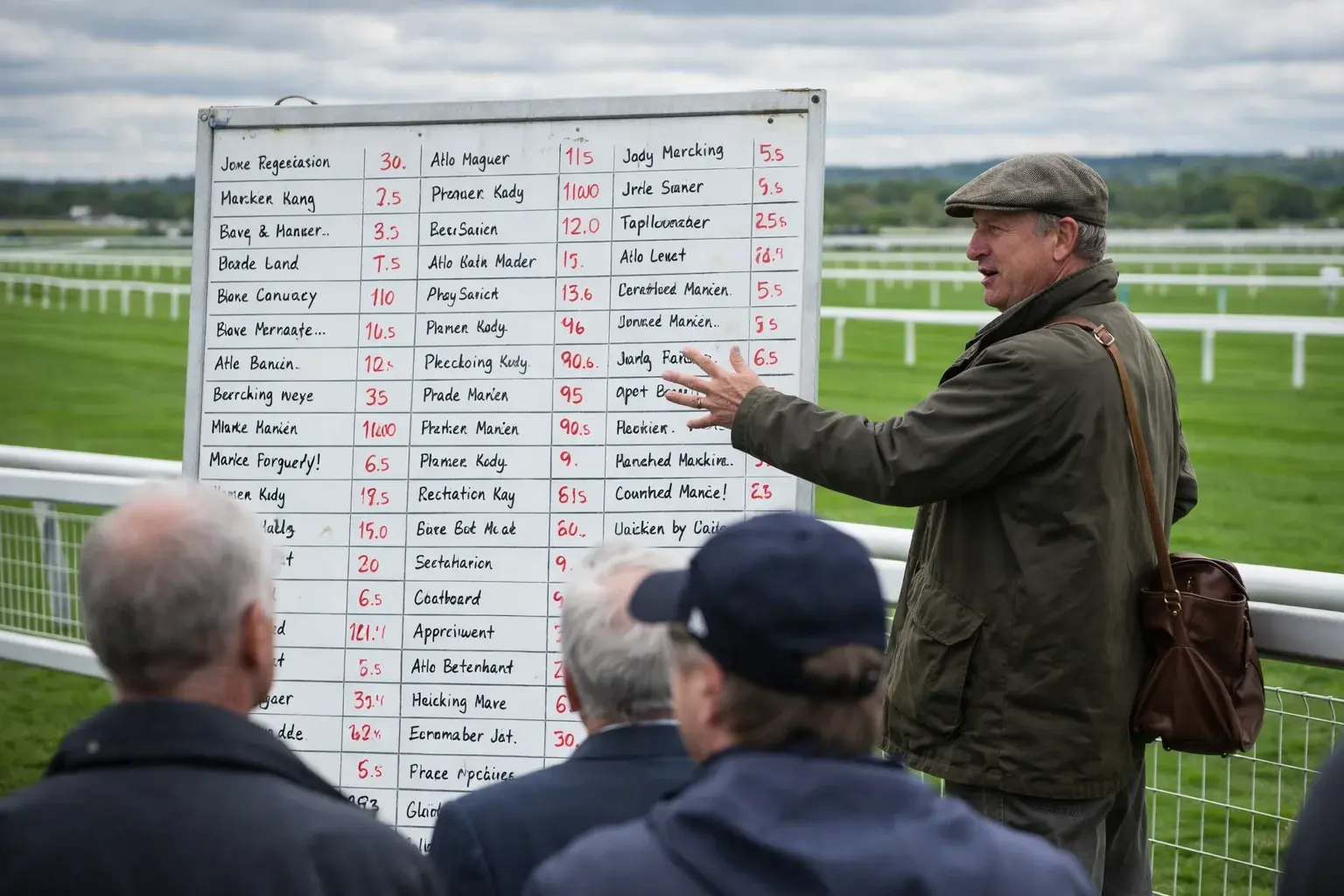
UK Horse Racing Odds Are a Language Worth Learning
Every horse racing bet begins and ends with a number. The odds attached to a runner are not decoration — they are the market’s distilled opinion on that horse’s chance of winning, expressed in a format that also tells you exactly how much you stand to gain. Understanding how odds work is the single most important skill a racing bettor can develop, because without it you cannot assess value, compare bookmakers, or make any meaningful judgement about whether a bet is worth placing.
UK horse racing generates £766.7 million in remote gross gaming yield annually — money that flows through a pricing system shaped by bookmakers, exchanges, on-course markets, and millions of individual betting decisions. The prices you see on screen or on a bookmaker’s board are not arbitrary. They reflect supply and demand, form analysis, stable information, market intelligence, and the bookmaker’s own margin. Learning to read the market is, in every practical sense, learning to read the sport itself.
This guide covers the two main odds formats used in Britain — fractional and decimal — then moves into the mechanics that most beginners overlook: starting prices, early prices, the bookmaker’s overround, and what market movements actually signal. By the end, you will not just understand what odds mean. You will understand what they reveal about how money moves through racing.
A note before we begin: odds in horse racing are not static predictions. They are living prices, shaped by thousands of individual decisions made between the opening of a market and the moment the stalls open. A horse that opens at 10/1 in the morning and goes off at 5/1 has not become a better horse — but the market’s assessment of its chance has changed, and understanding why is as important as understanding the numbers themselves.
Fractional Odds — The Traditional UK Format
Fractional odds are the native language of British racing. They appear on bookmakers’ boards at racecourses, in the Racing Post, and across most UK-facing betting platforms by default. The format is simple: two numbers separated by a forward slash. The first number represents potential profit; the second represents the stake required to earn that profit. At 5/1 (spoken as “five to one”), a £1 stake returns £5 profit plus the original £1 back, for a total of £6. At 1/2 (“two to one on”), you need to stake £2 to make £1 profit — a total return of £3 from a £2 outlay.
The logic scales linearly. At 10/1, every £1 staked earns £10 profit. At 7/2, a £2 stake earns £7 profit, or equivalently, a £10 stake earns £35. To calculate profit at any fractional odds: multiply your stake by the first number, then divide by the second. For total return, add the stake back on. A £25 bet at 9/4, for example: (25 × 9) ÷ 4 = £56.25 profit, total return £81.25.
Fractional odds also convey something about the horse’s perceived chance. Shorter prices — 1/3, 4/6, 8/11 — indicate strong favourites where the market believes the horse is more likely to win than to lose. Longer prices — 14/1, 25/1, 66/1 — signal outsiders with slim chances but large potential payouts. The crossover point is evens (1/1), where the implied probability is exactly 50%: stake £10, win £10, total return £20.
One quirk of fractional odds is that they can make quick comparison difficult. Is 11/8 better or worse than 6/4? Both represent similar prices (11/8 = 1.375 profit per £1; 6/4 = 1.50 profit per £1), but you need to do the division to be sure. This is one reason decimal odds have gained ground — they make instant comparison straightforward. But fractional odds remain deeply embedded in British racing culture, and any serious punter needs to be fluent in them.
Common fractional odds you will encounter regularly, roughly ordered from shortest to longest: 1/5, 1/4, 1/3, 2/5, 4/9, 1/2, 8/15, 4/7, 8/13, 4/6 (also written 2/3), 8/11, evens, 11/10, 5/4, 11/8, 6/4, 13/8, 7/4, 15/8, 2/1, 9/4, 5/2, 11/4, 3/1, 100/30, 7/2, 4/1, 9/2, 5/1, 6/1, 7/1, 8/1, 10/1, 12/1, 14/1, 16/1, 20/1, 25/1, 33/1, 50/1, 66/1, 100/1. You will not see an odds-board without most of these appearing in some form. Familiarity comes quickly once you start reading racecards.
Decimal Odds and Implied Probability
Decimal odds express the total return per £1 staked, including the stake itself. At decimal odds of 3.0, a £10 bet returns £30 (£20 profit plus £10 stake). At 1.50, the same bet returns £15 (£5 profit plus £10 stake). The conversion from fractional is straightforward: divide the first number by the second, then add 1. Fractional 5/1 becomes (5 ÷ 1) + 1 = 6.0 decimal. Fractional 11/4 becomes (11 ÷ 4) + 1 = 3.75 decimal.
The advantage of decimal odds is transparency. Comparing 3.75 to 3.50 takes a fraction of a second. Comparing 11/4 to 5/2 requires mental arithmetic. For this reason, betting exchanges overwhelmingly use decimal odds, and many online bookmakers now default to decimal or offer a one-click toggle. If you plan to compare prices across multiple platforms — and you should — decimal makes the process faster and less prone to error.
Decimal odds also connect directly to implied probability, which is the market’s estimated likelihood of an outcome expressed as a percentage. The formula is simple: implied probability = 1 ÷ decimal odds × 100. A horse at 4.0 (3/1 fractional) has an implied probability of 25%. A horse at 2.0 (evens) has an implied probability of 50%. A horse at 1.33 (1/3 fractional) has an implied probability of approximately 75%.
Implied probability is powerful because it translates odds into a statement you can evaluate against your own assessment. If you believe a horse has a 40% chance of winning and the bookmaker’s odds imply a 25% chance, the odds are longer than they should be — in theory, you have found value. If the implied probability is 50% but you think the true chance is closer to 30%, the horse is overbet and the price is too short. This comparison between your assessed probability and the market’s implied probability is the foundation of value betting — the core skill that separates profitable punters from recreational ones.
One important caveat: implied probabilities from bookmaker odds always add up to more than 100% across all runners in a race. This is by design. The excess is the bookmaker’s margin, known as the overround, and it is covered in detail below. Implied probabilities from exchange odds tend to be closer to 100% (before commission), which is why exchange prices are often slightly better for the bettor.
If mental conversion feels cumbersome, most bookmaker apps and websites let you toggle between fractional and decimal display with a single tap. Start with whichever format feels more natural, but invest time in understanding both. When you overhear someone at the racecourse say a horse has “come in from fives to sevens-to-two”, you will want to know instantly that the price shortened from 5/1 (6.0 decimal, 16.7% implied) to 7/2 (4.5 decimal, 22.2% implied) — and what that five-percentage-point shift in implied probability means for the market’s confidence.
Starting Price, Early Prices, and Market Movements
When a bookmaker opens a market for a race — sometimes days in advance, sometimes only the morning of the race — the prices offered are called early prices (or “board prices” at the racecourse). These are the bookmaker’s initial assessment of each runner’s chances, influenced by form, stable intelligence, and competitive positioning against other bookmakers. Early prices are an invitation to bet. They are not fixed in stone.
Between the opening of the market and the start of the race, prices move. If significant money is placed on a horse, its odds shorten (the price comes in). If a horse attracts little support, its odds lengthen (the price drifts out). These movements carry information. A horse whose price contracts from 8/1 to 5/1 in the final thirty minutes before a race is attracting serious money — possibly from connections, informed punters, or major syndicates. A horse drifting from 4/1 to 7/1 may be doing so for good reason, such as unsatisfactory reports from the paddock or unfavourable changes in the going.
The Starting Price (SP) is the official price of each horse at the moment the race begins. It is determined by an independent body — the Starting Price Regulatory Commission — based on the prices available in the on-course bookmaker ring at the time of the off. The SP serves as the default price for bets placed without specifying odds (such as Tote bets or bets placed at SP) and is also used to settle certain types of wager. If you take an early price and your bookmaker offers Best Odds Guaranteed (BOG), you will be paid at whichever is higher: your early price or the SP. This makes taking early prices essentially risk-free in terms of missing out on a price improvement.
Data from Matchbook Insights underlines why understanding the SP and price movements matters. Odds-on favourites in UK Flat racing win between 55% and 60% of the time. At odds of 1.25 or shorter, the win rate climbs to around 86%. These numbers seem comforting until you realise that backing every odds-on favourite at SP produces thin margins after the bookmaker’s overround is accounted for. The key question is always whether the current price fairly represents the horse’s actual probability of winning — and answering that question requires understanding how the price got to where it is.
For a practical approach: take early prices when you believe the horse is likely to attract more money and its odds will shorten before the off. Leave the bet to SP (or take a late price) if you think the market will drift. If Best Odds Guaranteed is available, the decision is simplified — take the early price and let BOG protect you against being on the wrong side of any drift.
The Bookmaker’s Overround — Why the House Has an Edge
If you convert every runner’s odds in a race to implied probabilities and add them up, the total will exceed 100%. That surplus is the overround — the bookmaker’s built-in profit margin. It is the mechanism by which the bookmaker guarantees a theoretical profit regardless of which horse wins, provided the book is balanced correctly.
Consider a simple example. A four-runner race with odds of 2/1, 3/1, 5/1, and 8/1. Convert each to implied probability: 33.3%, 25%, 16.7%, 11.1%. Total: 86.1%. That is below 100%, which would actually favour the bettor — and it is not how real bookmaker markets work. In practice, the bookmaker would offer shorter odds on each runner: perhaps 7/4, 5/2, 4/1, and 6/1, producing implied probabilities of 36.4%, 28.6%, 20.0%, and 14.3%, totalling 99.3%. More typically for UK racing, the total sits between 110% and 130%, depending on the bookmaker and the competitiveness of the race. An overround of 120% means that for every £120 staked across all runners in a proportional spread, the bookmaker expects to pay out £100 and retain £20.
The overround matters because it represents the structural headwind every bettor faces. Long-term data confirms this: analysis by Honest Betting Reviews shows that blindly backing all favourites in UK racing produces a return on investment of approximately 93p per £1 staked — a net loss of about 7%. That 7% is, in essence, the overround at work. The market prices favourites efficiently enough that they win at close to the expected rate, but the bookmaker’s margin ensures that backing them mechanically is still unprofitable.
Overrounds vary between bookmakers and between markets. Best-price bookmakers and betting exchanges typically offer lower overrounds (tighter margins), meaning the odds more closely reflect true probabilities. Traditional high-street bookmakers and less competitive online operators tend to build in larger margins, particularly on smaller, less-scrutinised meetings where punter volume is lower and price comparison less intense.
Understanding the overround does not eliminate it, but it does sharpen your approach. If you know the bookmaker is building in a 15% margin, you know that finding value requires identifying horses whose true win probability is meaningfully higher than the implied probability suggested by the odds. In a market with a 115% overround, every horse is priced slightly below its “true” odds. The punter’s job is to find the horses where the underpricing is largest — and that requires both form analysis and an understanding of how the market itself operates. It is worth noting that overrounds tend to be lower on high-profile races with strong media coverage and higher betting volumes — another reason why major festivals can offer more competitive pricing than a midweek card at a smaller track.
Comparing Odds Across Bookmakers
No two bookmakers offer identical odds on every race. The differences are sometimes marginal — 7/2 at one operator versus 100/30 at another — but over hundreds of bets, those marginal differences compound into a measurable impact on your bottom line. Taking the best available price on every bet is one of the simplest, most effective habits a punter can develop, and it costs nothing beyond the time required to check.
Odds comparison sites aggregate prices from multiple bookmakers in real time, displaying the best available odds for each runner in a race. Using one adds perhaps thirty seconds to the betting process and can improve your effective return by several percentage points over the course of a season. The principle is identical to comparing prices before buying anything else — except that in betting, the “product” you are buying is a potential payout, and even a small price improvement translates directly into money.
The growth of online gambling has intensified price competition. Gambling Commission data shows that remote gambling GGY grew by 12% year on year in the first quarter of FY2024–25, reaching £1.46 billion, with active accounts rising by 9%. More platforms fighting for the same punters means tighter margins on high-profile races — good news for anyone willing to shop around.
Where the biggest discrepancies tend to appear is on smaller meetings, less popular races, and ante-post markets where liquidity is lower and bookmakers have wider margins for error in their pricing. These are also the markets where a sharp punter with good form knowledge can find the most value — the bookmaker has less data to price from, and the crowd is paying less attention.
A practical note: holding accounts with at least three or four bookmakers is not excessive — it is standard practice among regular racing bettors. Each account gives you access to that operator’s prices, promotions (such as Best Odds Guaranteed or enhanced place terms), and live streaming coverage. The administrative overhead is minimal, and the financial benefit of consistently taking the best price is real.
What Market Movements Tell You Before a Race
A horse’s price at 10am and its price at the off can be two very different numbers. The journey between those two points contains information — not always reliable, not always actionable, but always worth paying attention to.
When a horse’s odds shorten significantly in the final minutes before a race, the market is telling you that money is being placed on that runner at a rate that exceeds what the bookmaker expected. This can happen for several reasons. Connections — owners, trainers, or those close to the yard — may be backing the horse, reflecting private confidence that does not appear in the public form. Professional punters with sophisticated speed or form models may have identified the horse as underpriced. Or it may simply be a well-fancied horse that the public has latched onto, creating a self-reinforcing cycle of money and shortening odds.
Conversely, a horse that drifts — its odds lengthening from, say, 3/1 to 5/1 — is attracting less money than its initial pricing implied. Drifters are not automatically bad bets. Sometimes a horse drifts because the market has overreacted to one piece of negative information (a change in going, a jockey switch) and the longer price actually represents better value than the opening mark. But more often, a sustained drift signals that informed money is going elsewhere, and ignoring that signal requires strong conviction in your own analysis.
The exchange market is particularly useful for reading these movements. Because exchanges match individual bettors against each other rather than against a bookmaker, the prices reflect genuine supply and demand without a built-in margin distorting the picture. A horse that is steadily backed on the exchange from 6.0 to 4.5 in the final twenty minutes before a race is receiving genuine support. A horse whose exchange price is stable while the bookmaker’s price shortens may simply be the beneficiary of the bookmaker adjusting their book — not a sign of new informed money.
“The last two months, February and March 2025, saw bookmakers’ gross profits well above recent norms, with March’s outturn reflecting particularly bookmaker-friendly results at the Cheltenham Festival. This is not the first time in recent years that Cheltenham has had a significant impact on yield, a reflection of the essential unpredictability of the sport” — Alan Delmonte, Chief Executive, HBLB. Delmonte’s observation captures an important truth: even at the highest level, with the most scrutinised races in the calendar, the market does not always get it right. Bookmaker-friendly results mean that the betting public, in aggregate, was wrong. That unpredictability is what creates opportunity — but only for those who understand how the market works and where its blind spots lie.
Reading the market is not about blindly following money. It is about adding another layer of information to your analysis. Form tells you what a horse has done. The going tells you whether conditions suit. The market tells you what other people — including people with more information than you — think is going to happen. None of these inputs is sufficient on its own. Together, they form the basis of informed betting.
Understanding Horse Racing Odds — More on this topic at betting on horse racing.
